10 free tools. Zero signups. Your files never leave your browser.Open the Viral Lab →
Every TikTok, Instagram and YouTube change that actually matters for creators in 2026, in date order, with sources, what each one means for you and which ones you can ignore.
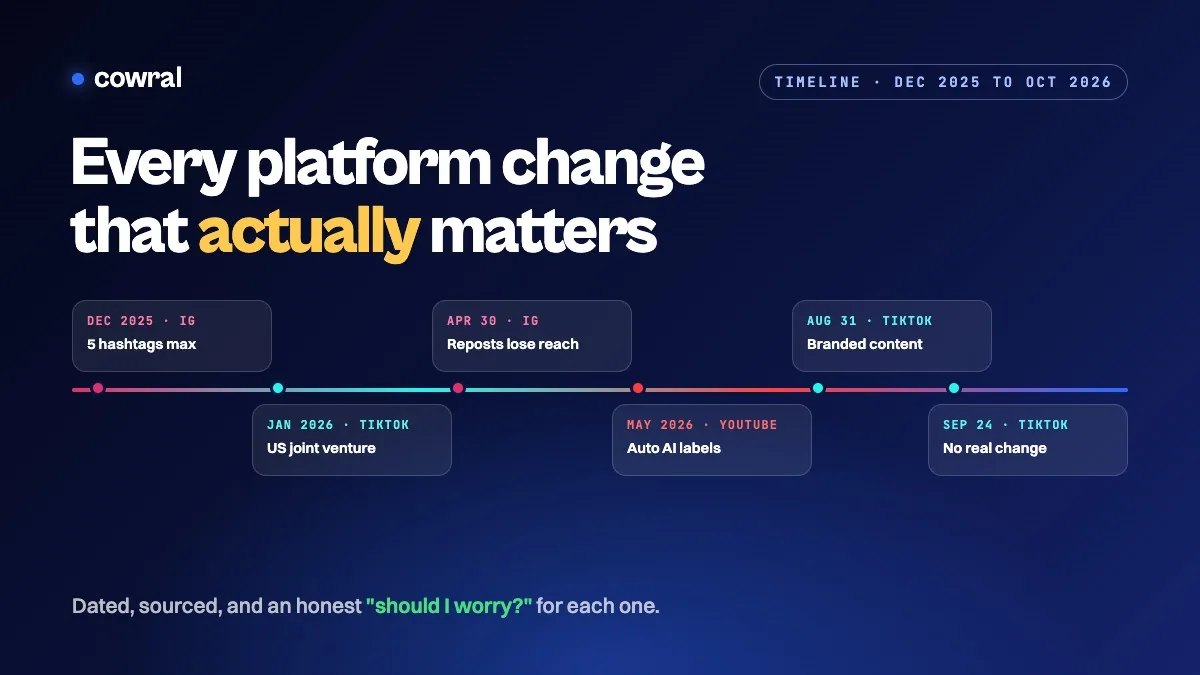
Every few weeks a post goes around saying the algorithm “just changed” and your reach is about to fall off a cliff. Sometimes there’s a real change behind it. Often it’s a rewording of a policy page, a test that reached 2% of users, or nothing at all.
This is the list we wish existed: the TikTok, Instagram and YouTube changes from late 2025 through October 2026 that actually affect American creators, in date order, each with a source, what it means for you and an honest “should I worry” note.
Key takeaways
| Date | Platform | Change | Do something? |
|---|---|---|---|
| Dec 2025 | “Your Algorithm” topic controls for viewers | Make your topic obvious | |
| Dec 2025 | Five hashtags max | Yes, trim to five | |
| Jan 2026 | TikTok | US joint venture, US-trained algorithm | Watch your analytics |
| Apr 30, 2026 | Originality rules cover photos and carousels | Yes, if you repost | |
| May to Jun 2026 | FAQ rich results removed | Only if you blog | |
| Late May 2026 | YouTube | Automatic labels for realistic AI | Yes, if you use AI visuals |
| Aug 31, 2026 | TikTok | Branded content rules updated (reported) | Yes, if you do deals |
| Sep 23, 2026 | YouTube | Made on YouTube tool announcements | Not yet |
| Sep 24, 2026 | TikTok | Community Guidelines notice | No |
Instagram rolled out “Your Algorithm,” starting with Reels in the US. Viewers can see the topics Instagram thinks they like and add or remove them. Later reports say it expanded to Feed and Explore in 2026.
What it means for you: if people can tell Instagram “more cooking, less fitness,” a page that bounces between five topics is harder to place. Accounts with one clear subject are easier for both the viewer and the system to file correctly. This doesn’t mean you can never post off-topic, just that your main lane should be obvious from your last nine posts.
Instagram now limits posts and Reels to five hashtags. Adam Mosseri said hashtags help with search but “don’t increase your reach,” and that a few specific tags do better than a long generic list.
Some tool blogs claim extra tags trigger demotion or that the first comment counts toward the cap. We couldn’t find Instagram confirming either, so treat those as rumors. The safe move is simple: five specific tags, in the caption.
Cowral’s free Tag & Hashtag Generator already caps Instagram at five. Here it is for “apartment organization”:
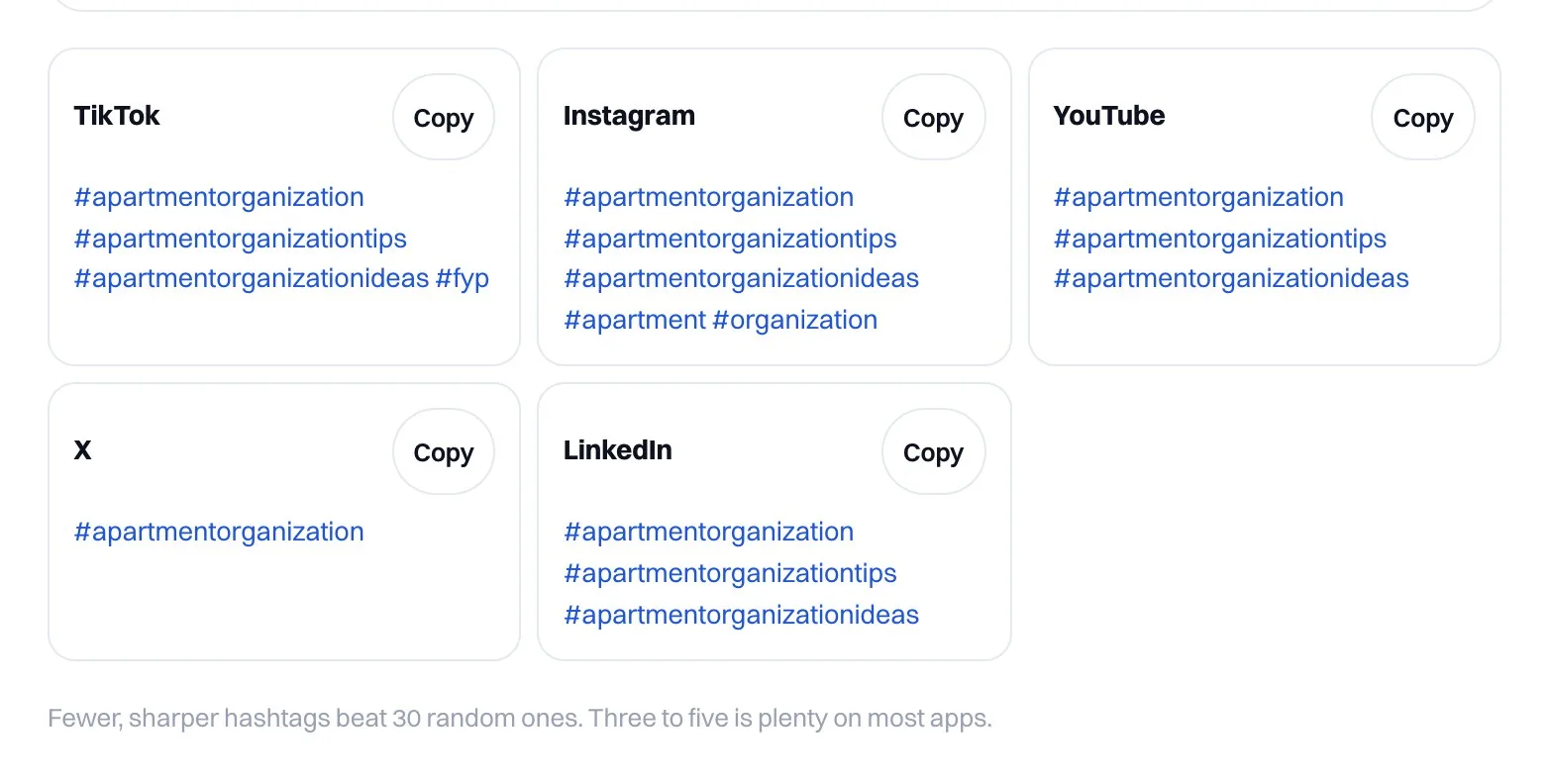
Notice the mix: the exact topic, a slightly broader version and one or two related tags. Skip #reels, #explore and #fyp on Instagram. They’re too broad to help anyone find you.
The deal creating a US joint venture for TikTok closed around January 22, 2026. Oracle, Silver Lake and MGX each hold 15%, and ByteDance keeps 19.9%. The joint venture said it would retrain the recommendation algorithm on US user data.
What it means for you: the app works the same on your end, and there’s no switch to flip. But a retrained algorithm can shift what gets pushed, especially for accounts that relied on international audiences. If your views moved in early 2026, compare your US and non-US audience split in TikTok analytics before assuming you did something wrong.
"TikTok is getting banned" is no longer the story
The US joint venture is what kept TikTok running in the US. If you’d been holding back on TikTok because of ban talk, that particular reason is gone.
Instagram had already been replacing reposted Reels in recommendations with the original creator’s version. On April 30, 2026, it extended that approach to photos and carousels. Accounts that mostly share content they didn’t create, or didn’t meaningfully change, won’t be recommended to people who don’t already follow them.
What it means for you: if you make your own content, this works in your favor, because aggregator pages lose the reach they used to get from your work. If you run a meme or quote page, adding a caption or a border isn’t enough. You need real commentary, a remix that changes the meaning, or your own material.
Google confirmed on May 7, 2026 that FAQ rich results no longer appear in search, and removed the related reports and testing support in June.
What it means for you: only something to think about if you run a blog or website next to your channels. FAQ sections still help readers and can still be quoted in AI answers, they just don’t get the expandable dropdown in Google anymore. You don’t need to remove existing FAQ markup.
YouTube started adding AI labels automatically to photorealistic AI content that creators didn’t disclose. The label shows under the player, or on top of a Short. YouTube’s Rene Ritchie said the label doesn’t affect recommendations or monetization.
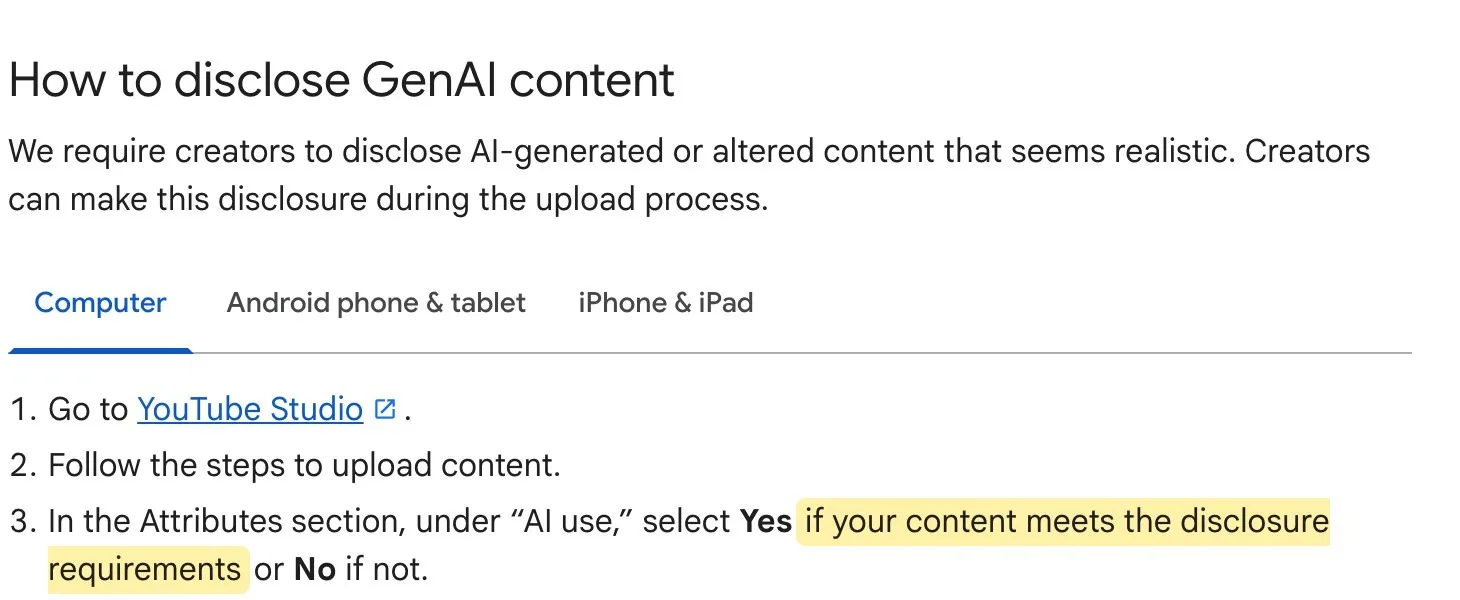
What it means for you: your reach is safe, but your audience’s trust might not be. Being labeled by YouTube looks worse than disclosing it yourself. If you use realistic AI footage, voices or faces, set “AI use” to Yes under Attributes when you upload in YouTube Studio. AI used for scripts, captions or color grading doesn’t need a label.
This adds to the 2025 "inauthentic content" rule
Since July 15, 2025, YouTube’s Partner Program rules spell out that mass-produced or repetitive videos can’t earn. AI isn’t banned, but a channel of near-identical AI slideshows is exactly what that rule is aimed at.
According to industry reports, an updated TikTok Branded Content Policy took effect on August 31, 2026. As reported, it counts reviews of gifted products as branded content, moves some categories (such as supplements, over-the-counter medicine, financial services and underwear) into a restricted tier that requires TikTok-approved partnerships, and adds rules against content that promotes negative body image.
We couldn’t find TikTok’s own announcement, so check the current Branded Content Policy in TikTok’s help center before you sign a deal in one of those categories.
What it means for you: turn on the branded content toggle for anything gifted or paid, and remember that FTC disclosure rules apply on top of TikTok’s.
YouTube’s annual event announced Ask Studio features that review drafts and suggest catalog improvements, Dynamic Thumbnails, A/B testing for Shorts (up to three different cuts) planned for 2027, a live auto-dubbing pilot in early 2027, and affiliate auto-tagging.
What it means for you: mostly nothing yet. These roll out over months, often to bigger channels first. The one to watch is Shorts A/B testing, because it will let small channels test edits instead of guessing.
TikTok sent out a notice about an updated Community Guidelines page effective September 24, 2026. Trackers that compare versions of the page found wording and layout edits but no substantive rule changes.
What it means for you: nothing. If a video’s reach fell around that date, look at the video itself before blaming the guidelines.
A few changes from 2024 and 2025 still shape how things work:
Before you change your strategy because of a viral “algorithm update” post, ask three things:
Most reach drops come from the content, the timing or the topic, not a secret update. If you’re not sure when your audience is around, Cowral’s Best Time to Post is a reasonable starting point while you build up your own data.
Cowral tracks what’s trending in your niche on TikTok, Instagram and YouTube, writes hooks, captions and titles, and keeps its tools in line with platform rules like Instagram’s five-hashtag cap. When a platform rule changes, we update the tools.
You can start free, no card needed.
Yes, in a few ways. Viewers can now edit their own recommendation topics with “Your Algorithm,” hashtags are capped at five, and since April 30, 2026, accounts that mostly repost others’ photos and carousels, not just Reels, lose recommendations to non-followers.
Five at most, because that’s Instagram’s cap. Three to five specific tags usually work better than broad ones like #reels or #explore.
The US joint venture that closed in January 2026 said it would retrain the algorithm on US user data. The app works the same for creators, but what gets recommended to US viewers may shift. Check your audience location data if your views changed.
YouTube says no. The automatic AI label doesn’t affect recommendations or monetization. It can affect how viewers trust your channel, so disclose realistic AI yourself when you upload.
Yes. Turn on the branded content toggle, and follow the FTC’s rules for disclosing material connections, which include free products.
Look for a primary source, like a platform announcement or help page, check whether it’s fully rolled out or only a test, and compare it with your own analytics before changing anything.

Olu Sam is an SEO expert and social media content creator who built over 50K followers across his social media pages in less than a year of creating content.
LinkedIn ProfileHow we research and fact-check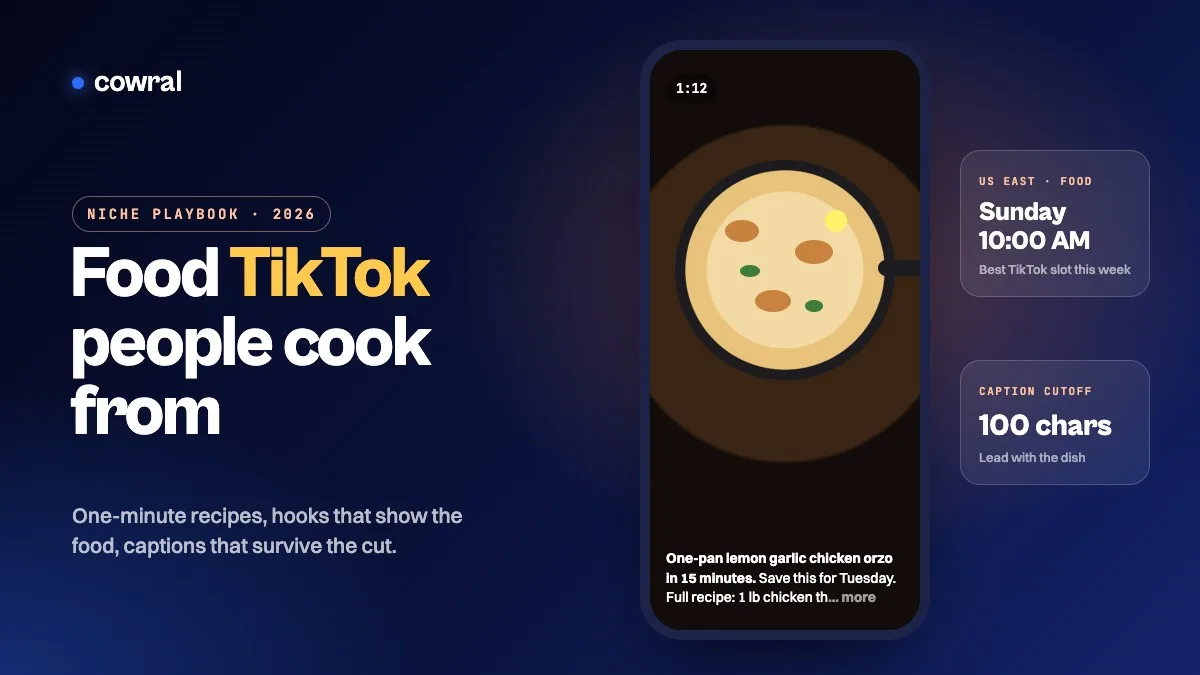 TikTokFood creators on TikTok in 2026: how to grow a recipe account people actually cook fromA 2026 playbook for food creators on TikTok, covering what the Creator Rewards Program pays for, hooks and captions that work for recipes,...
 YouTubeTech YouTube in 2026: a channel strategy for small creators who review, explain and buildHow to grow a small tech YouTube channel in 2026, from picking a buyer instead of a gadget and writing titles that don't get cut off to the...
 YouTubeLifestyle YouTube in 2026: what's working now for small vlog channelsHow to grow a lifestyle or vlog channel on YouTube in 2026, from building for TV viewers and writing titles people can picture to Shorts...