10 free tools. Zero signups. Your files never leave your browser.Open the Viral Lab →
Everyone tells you to write a better hook. Almost nobody shows you the receipts. So we did something slightly obsessive.
Everyone tells you to write a better hook. Almost nobody shows you the receipts.
So we did something slightly obsessive. Instead of publishing another list of hooks we made up on a Tuesday, we pulled every credible TikTok hook study from the last year, the ones built on real datasets, not vibes, and cross-checked what they actually found. Between them, these studies tagged and measured well over 43,000 videos. When separate teams analyzing separate data land on the same handful of patterns, that is the closest thing this industry has to a fact.
Seven formats show up again and again. Below is each one, ranked by what the data says, with the part almost every other article skips: the same hook does not perform the same way on TikTok, Instagram, and LinkedIn, and it does not perform the same way in every niche. A hook that prints views for a sports account can flop for a skincare brand. We will show you where each format wins and where it quietly dies.
Fair warning before we start. This is not a “post this exact sentence and go viral” article. Those are lying to you. Hooks raise your odds. They do not remove the coin flip.
Before you write another hook
Cowral generates hooks and full scripts tuned to your specific niche, then tracks which ones actually grew your account on the Success Dashboard. So your next hook is built on what worked for you, not on a generic list.
Try Cowral free, no card needed →Key takeaways
Here is the mechanic you are actually working with. TikTok does not show your video to a million people and see what happens. It shows it to a small test pool first, a few hundred accounts, and watches what they do. If enough of them stay, it widens the pool. If most swipe away early, the video stalls, often below a few hundred views, and quietly dies. Your content never gets judged on its substance. It gets judged on its open.
And that judgment happens fast. The algorithm forms an early read on your video in roughly 1.5 seconds. Retention before the 3-second mark shapes the height of your entire retention curve, so a weak open does not just lose one viewer, it drags down the completion rate that decides whether anyone else ever sees the thing. One analysis of underperformers put it bluntly: 90% of them fail in the first three seconds.
None of this is unique to TikTok, but TikTok is the most demanding version of it. Retention benchmarks there run higher than on other platforms, which means content that struggles on TikTok should be re-cut with a tighter hook before it goes to Instagram Reels or YouTube Shorts, where softer signals can partly cover for a slow start. If you only fix your hooks for one platform, fix them for TikTok. The rest inherit the upgrade.
So the hook is not the decoration on the video. It is the thing being tested. Everything else is what happens if you pass.
We did not run one study and pretend it was the whole truth. We compared several, because each one measures something slightly different and each has a bias worth naming.
Here is the honest part. These studies do not agree on a single ranking, because “best” depends on whether you are counting views, engagement, or click-through, and on which platform. A bold opinion tops the engagement charts. Showing the result tops the view charts. Both are true. So instead of pretending there is one champion, we mapped the 7 formats every study kept surfacing and told you what each one is actually good at.
One number that should reset your expectations: in The Content Labs data, the gap between the best and worst hook-delivery combinations was roughly 14x on median views. The format matters. How you deliver it matters just as much.
Know your niche’s numbers, not a generic average
There is no universal best hook, just like there is no universal best time to post. A fitness audience and a finance audience reward different opens. Cowral surfaces what is rising inside your niche specifically.
See your best time to post, free →Ranked loosely by how consistently they showed up near the top across studies. Treat the order as a starting point, not a law. For each format you get what it is, what the data says, when to use it, and how it shifts across platforms, which is the part that will actually change your results.
You open by rejecting something your audience assumes is true. Not just an opinion. A direct contradiction of the default belief. “Posting times do not matter. Here is what actually does.” The viewer’s brain snags on the contradiction and cannot leave it unresolved, so they stay to find out how you back it up.
What the data says: This format carries the highest viral ceiling in The Content Labs dataset, with its top video hitting 17.7M views. People share contrarian takes to start arguments, which is free distribution. OpusClip flags the same pattern as one of its five winners and adds the warning that matters most here.
The catch: Do not cry wolf. If your contrarian open is followed by weak content, you train your audience to ignore you, and that damage compounds. Only flip a belief you can actually back up.
Across platforms: On TikTok, sharp and fast. On Instagram, it works but skews softer, more “here is what everyone gets wrong” than a full attack. On LinkedIn, this is arguably the strongest format on the platform, because contrarian professional takes drive comments, and LinkedIn rewards comments harder than any other network. Same hook, three different temperatures.
Templates you can steal
Close cousin of the Flip, but you are not contradicting a belief, you are stating a strong opinion with zero setup. “This is the single greatest game in baseball history.” No context. Just a take people have to agree or disagree with.
What the data says: In The Content Labs analysis, the Hot Take had the highest average engagement rate of any format at 7.8%. It is built for the comment section. People argue, tag friends, and quote you in their own videos, all of which the algorithm reads as strong interest.
When to use it: When you have a real opinion about something your audience already cares about. Sports, pop culture, industry drama, anything with a built-in fanbase that loves to debate. If nobody could possibly disagree with your take, it is not a hot take, it is a fact, and it will not travel.
Across platforms: TikTok and Instagram love a hot take delivered straight to camera. On LinkedIn, dial the heat down and aim it at a professional belief, or you read as someone picking a fight in a business suit.
Templates you can steal
You open a question or a mystery the viewer needs closed. “Here is why the Celtics hired a chess prodigy.” Now they have to keep watching to get the answer, because you opened a loop their brain wants shut.
What the data says: This was the most common hook in The Content Labs dataset, in 2,041 videos, and it holds their single highest-viewed video at 69.7M views. It also pulled the highest average views of any format. If you make explainers, breakdowns, or storytime content, this is your bread and butter.
When to use it: Any time there is a “why” or “how” your audience wants answered. It works across basically every niche, which is exactly why it is the most common. The risk of common is that it is also the most imitated, so your loop has to be genuinely interesting, not “you will never believe what happened next.”
Across platforms: Universal. The open loop is the most portable format in this list. It performs on TikTok, Instagram, and LinkedIn with only light rewording, because curiosity is platform-agnostic. If you only master one format, master this one.
Templates you can steal
Instead of telling people something is impressive, you show the finished thing in the first frame. The transformation. The result. The product mid-action. The viewer knows within two seconds exactly what they get if they stay, and that certainty earns the watch.
What the data says: In OpusClip’s dataset, the outcome showcase was the top format by average views at 6,037 per clip, roughly 2x the lowest-ranked format. The Content Labs’ version of this, “Show Something Wild,” pulled the second-highest average views in their data. Two separate studies, same finding: showing beats telling.
When to use it: When you have something visual worth showing. Tech demos, product reveals, cooking, before-and-afters, any transformation. The rule is simple. Do not describe it. Show it. The hook is the demo.
Across platforms: This is where platform choice matters most. On TikTok and Reels, the visual outcome in frame one is close to unbeatable. On LinkedIn, a pure visual reveal underperforms, because LinkedIn viewers scan for the takeaway in text, so pair the visual with a one-line result they can read with the sound off.
Templates you can steal
You skip the intro and lead with a specific number. “50,000 followers in 4 posts.” “80% of autoimmune diseases happen to women. Why?” A stat lands as credible and specific, and specificity stops the scroll in a way that vague claims never do.
What the data says: This format ranked lower on average engagement in The Content Labs data, yet held their second-highest top video at 28.1M views. Translation: it is streaky. When the proof is strong enough, nothing else matters, and it goes massive. When the number is boring, it does nothing. There is a reason the specific number shows up as a named winner in OpusClip’s set too, and specificity is the whole engine. “I lost 23 pounds in 67 days” beats “I lost weight,” every time, because odd, specific numbers read as real experience, not marketing.
When to use it: When you have real numbers. Case studies, results, before-and-after stats, listicles. Never round up to a prettier number. The oddness is the credibility.
Across platforms: The Proof Drop is the one format that arguably performs best on LinkedIn, where an audience of professionals is primed to respect data. On TikTok it works but needs energy behind it. On Instagram, put the number in on-screen text, not just the voiceover, so it registers in the half-second before the caption loads.
Templates you can steal
No intro, no graphics, no “hey guys, welcome back.” You pick up the phone mid-thought and talk like you are FaceTiming one person. Raw, unpolished, a little urgent. In a feed of over-produced content, realness stands out.
What the data says: In The Content Labs data this format pulled fewer average views but high engagement, because the people who do stay feel a real connection and comment “this is literally me.” It trades reach for intensity. OpusClip’s most aggressive relative of this, the imperative command (“stop scrolling”), is the most divisive pattern they measured: brilliant when the payoff is genuinely high-stakes, desperate when it is not.
When to use it: When you are speaking from real emotion or personal experience. Rants, reactions, motivation, anything where being real matters more than being polished. Skip the “stop scrolling” command unless you actually have a stop-scrolling reason.
Across platforms: TikTok rewards this most, it is the native language of the platform. Instagram tolerates it. LinkedIn can take a professionalized version (“I need to say something about how we hire”), but the raw FaceTime energy reads as oversharing in a business context. Match the intimacy to the room.
Templates you can steal
You open by telling people what is about to happen. “AI is going to take over social media in under 12 months.” You position yourself as someone who sees around corners, and viewers stay to judge whether you are right, then bookmark you to check later.
What the data says: The Content Labs logged this format’s top video at 14.4M views. Predictions are shareable by nature, because people either want to prove you wrong or say “I told you so” later, and both reactions spread the video.
When to use it: When you have a real read on where your space is heading. Tech, finance, sports, culture, any niche with a constant “what happens next.” A prediction with no reasoning behind it is just noise, so back the call with a why.
Across platforms: Predictions travel well everywhere, but the timeframe should shrink as the platform gets more serious. On TikTok, a bold “this changes everything” prediction flies. On LinkedIn, a grounded “here is where I think this market moves in 18 months” lands better than hype.
Templates you can steal
Turn a hook into a full script in your voice
Picking the format is step one. Writing the whole video around it, in a voice that sounds like you and not a robot, is where the hours go. Cowral writes the hook and the full script tuned to your niche, so you edit two lines instead of starting from a blank page.
Generate your first script free →Do not memorize seven categories and agonize. Match the format to the content you already have.
Then rotate them. The best creators do not repeat their one winning format until it goes stale. They cycle: one Flip, one Open Loop breakdown, one Proof Drop case study. Variety keeps both the algorithm and the audience awake, and it teaches you which formats actually work for your account instead of everyone else’s.
Which brings up the thing no generic list can give you. The rankings above are averages across thousands of other people’s videos. Your account is not average. The only ranking that matters is the one built from your own posts, in your own niche, measured over time. That is the entire reason the Success Dashboard exists, to turn “hooks that work in general” into “hooks that work for you.”
Some openers are not weak. They are actively costing you the test pool. Across the studies, these underperform consistently. If any are in your current template, rewrite them:
The fix for all four is the same. Cut the runway. Start on the single most interesting second of your video, and let the context catch up later. Most underperforming videos do not have a bad idea. They have a great idea buried three seconds too deep.
Tool or no tool, that is the whole game in 2026. The idea is rarely the problem. The first three seconds are. Fix those, and everything you already know how to make gets a second chance to be seen.
Stop guessing which hook to use
Cowral finds the trends rising in your niche, writes hooks and scripts around them, and shows you what is actually growing your accounts. Built for creators posting across TikTok, Instagram, YouTube, X, and LinkedIn.
Start free, no card needed →There is no single best hook, and any article claiming one is oversimplifying. It depends on what you count. For engagement, the Hot Take topped The Content Labs’ analysis at a 7.8% average. For views, the Outcome Showcase topped OpusClip’s at around 6,037 average views per clip. The honest answer: the best hook is the one that fits your content, your niche, and your platform. Rotating formats beats forcing one.
The hook window is the first three seconds. TikTok’s algorithm forms an early read around 1.5 seconds, and over 70% of viewers decide to stay or scroll inside three. Your hook should deliver its premise, credibility signal, or payoff preview before the three-second mark. After that you are keeping people, not hooking them.
No. Introduction-style openers underperform consistently across every dataset. The viewer scrolled to you, so you do not need to introduce yourself. Lead with the value, the take, or the visual, not the greeting.
The formats carry over, but the temperature changes. The Open Loop and Proof Drop travel almost unchanged. The Contrarian Flip is one of the strongest formats on LinkedIn but needs to target a professional belief. The raw Direct Address that wins on TikTok can read as oversharing on LinkedIn. Same skeleton, different delivery per platform.
Rotate through several rather than repeating one. Both the algorithm and your audience reward variety, and cycling formats is also how you learn which ones actually perform for your specific account instead of relying on cross-account averages.
Largely, yes. One analysis of underperforming videos attributed roughly 90% of the failure to the first three seconds, and TikTok’s own research found 63% of the highest click-through videos surface their core message in that window. The open is not part of the video. It is the test the video has to pass.

Olu Sam is an SEO expert and social media content creator who built over 50K followers across his social media pages in less than a year of creating content.
LinkedIn ProfileHow we research and fact-check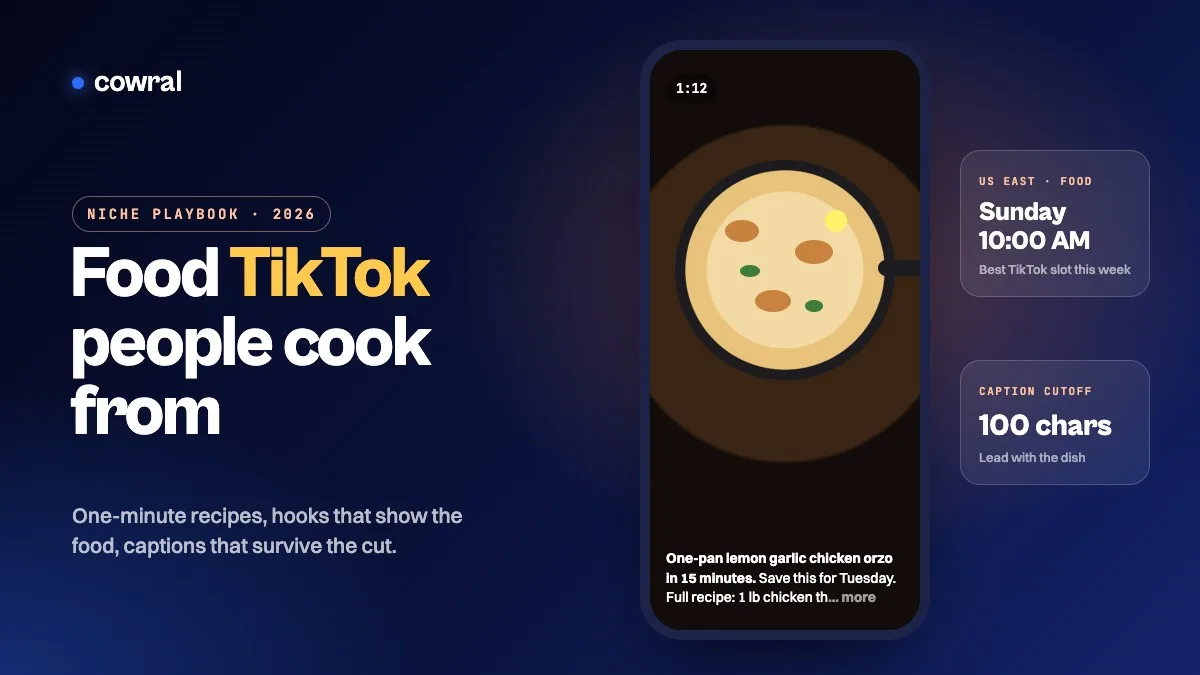 TikTokFood creators on TikTok in 2026: how to grow a recipe account people actually cook fromA 2026 playbook for food creators on TikTok, covering what the Creator Rewards Program pays for, hooks and captions that work for recipes,...
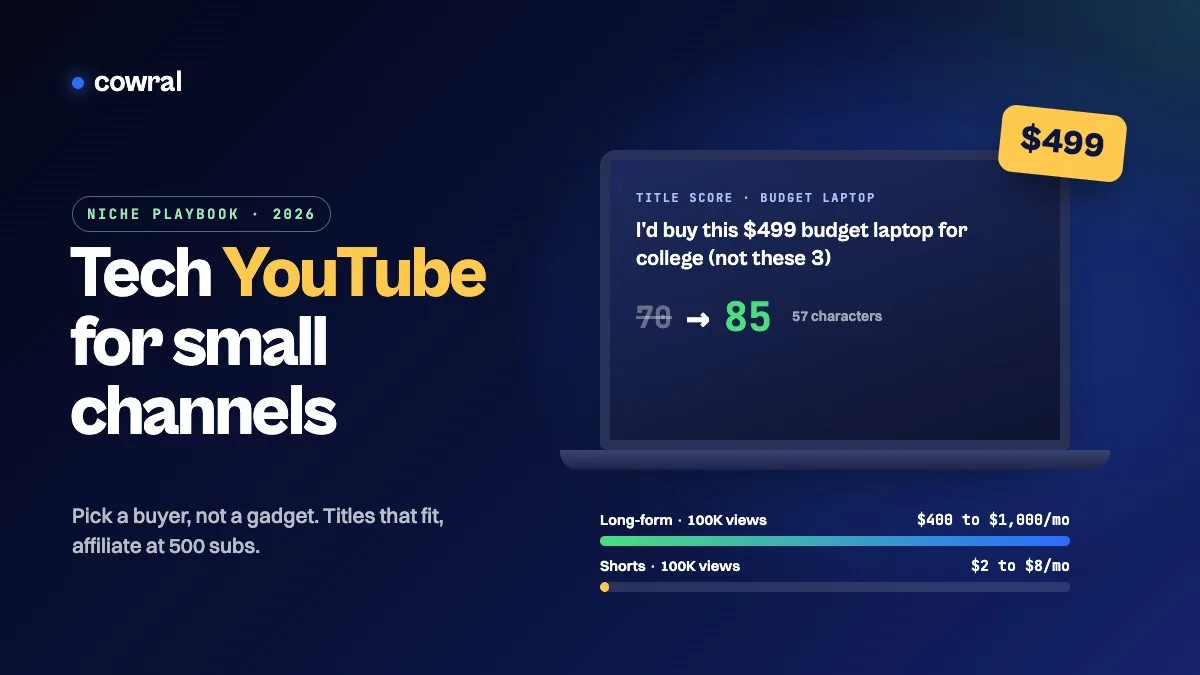 YouTubeTech YouTube in 2026: a channel strategy for small creators who review, explain and buildHow to grow a small tech YouTube channel in 2026, from picking a buyer instead of a gadget and writing titles that don't get cut off to the...
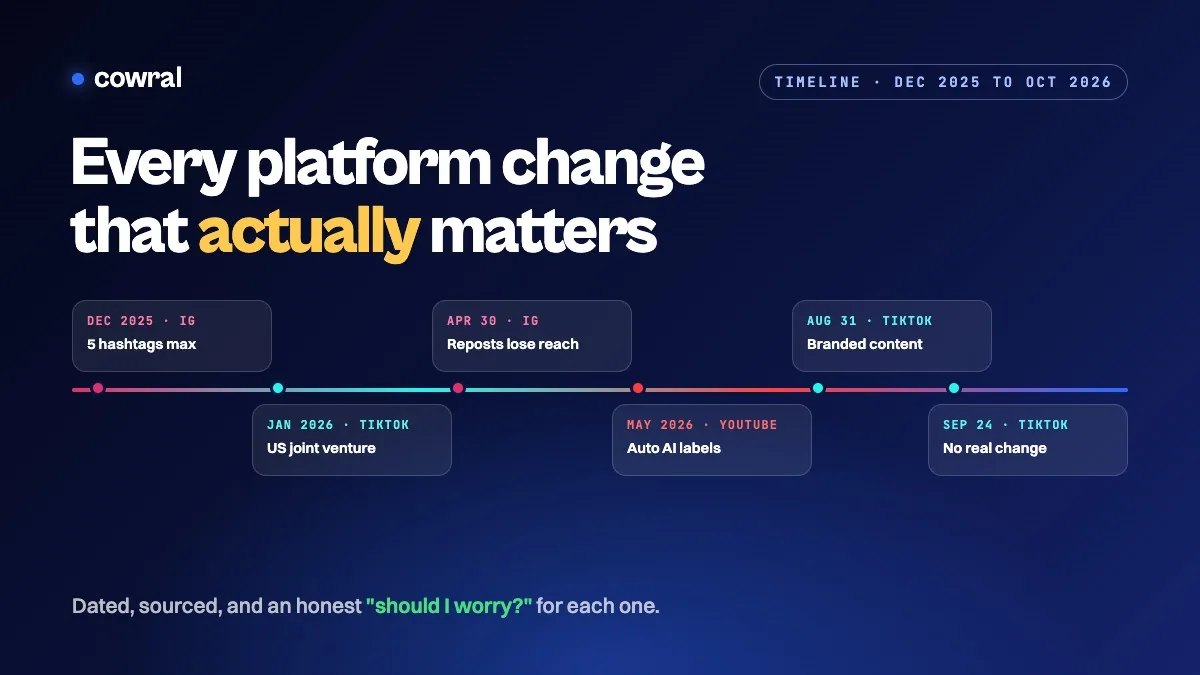 InstagramAlgorithm and policy changes creators need to know in 2026: a dated timelineEvery TikTok, Instagram and YouTube change that actually matters for creators in 2026, in date order, with sources, what each one means for...