10 free tools. Zero signups. Your files never leave your browser.Open the Viral Lab →
For 30 days I wrote nothing myself. Every hook on every TikTok came from an AI tool. This is what the numbers actually did, not what a tool's landing page promises.
Key takeaways
I need to explain why I did this, because “let AI do everything for a month” sounds like the kind of thing people do purely to make a video about doing it.
I run a small TikTok account in a niche I will keep vague, because this isn’t a flex post and the numbers aren’t big enough to flex with. Mid four figures in followers. The kind of account where most videos get a few thousand views and every so often one does 40k and you spend a week trying to figure out why. If you run an account like that, you already know the specific feeling I’m talking about. You are not failing. You are also not growing. You are just posting into a fog. I’d already made peace with a few hard truths about that plateau, including why posting more often was quietly making it worse, so the hook felt like the last lever I hadn’t pulled.
I’d gotten slow. Not lazy, slow. I was spending maybe forty minutes writing a single hook, rewriting it, saying it out loud in the car, hating it, rewriting it again. And I kept reading that AI could do this in seconds and that creators were testing “dozens of hooks and visual styles in a single week” now instead of agonizing over one. That volume shift is real and it’s already the baseline on TikTok, not some edge experiment. So I felt slow and a little stupid, doing by hand the thing everyone else had apparently automated.
So I made a rule and stuck to it for 30 days: I would write zero hooks. Every single one would come from AI. I would still film, still edit, still pick the topics, but the first three seconds, the part that actually decides everything, would not be mine. Then I’d track what happened and not lie to myself about it.
Here’s what happened.
Before the experiment, one thing worth getting straight, because it’s the reason any of this matters.
The hook stopped being important and became everything. TikTok’s algorithm now weights early retention exponentially, and a video that keeps 80 percent of viewers for the first 3 seconds gets better distribution than one that keeps 60 percent for the full 30. Read that twice. The platform would rather push a video people watch hard for three seconds than one they watch politely for thirty. Early retention is the whole ballgame, and it’s downstream of a bigger shift I’ve written about in the breakdown of what changed in TikTok’s 2026 algorithm.
And you get three seconds to earn it. Generic openers like “here’s how to grow on TikTok” lose about 70 percent of viewers in the first two seconds, while a specific hook can keep 75 percent watching past five. The gap between a good hook and a bad one isn’t a little edge. It’s the difference between the video existing and the video not existing.
So when I say I handed the hook to AI for a month, understand what I actually handed over. I gave a machine the single most important decision in each video and kept the easy parts for myself. That was the point. If AI is going to help, this is where it either helps or it doesn’t.
Before you write another hook
Cowral generates hooks and full scripts tuned to your specific niche, then tracks which ones actually grew your account on the Success Dashboard. So your next hook is built on what worked for you, not on a generic list.
Try Cowral free, no card needed →
No vague “I used AI” hand-waving. Here’s the real process so you can copy or criticize it.
I posted once a day, 30 days, no skips. For each video I picked the topic myself, then generated hooks three ways and rotated between them so I wasn’t testing one tool’s personality:
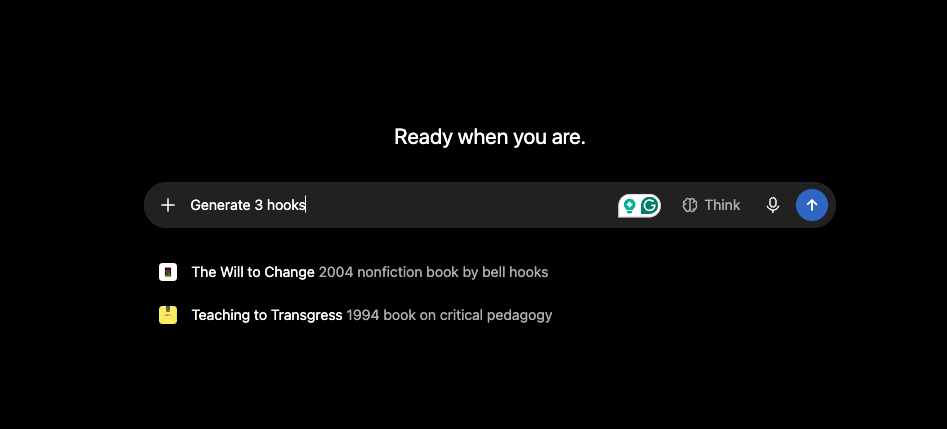
For each video I generated ten hooks, picked the one that made me feel something, and used it exactly as written. That last part was the discipline. No “I’ll just tweak this one word.” If AI wrote it, it shipped as written. Otherwise I’d be testing my editing, not the AI.
I tracked four numbers per video: three-second retention, average completion rate, total views, and saves. Completion rate was the one I cared about most, because it’s the metric TikTok’s algorithm weights most heavily, somewhere around 40 to 50 percent of the ranking decision according to Sprout Social’s read. If AI hooks were better, completion rate would show it.
The first week genuinely felt like cheating.
Forty minutes of hook agony became ninety seconds of reading a list. I’d paste my topic, get ten options, and at least three of them were better than what I’d have written on my own in an hour. The speed was not a small improvement. It was a different way of working. I filmed four videos in the time it used to take me to make one, because the part that used to stop me cold was just handled.
And the hooks were good. Not amazing, but good. Specific, punchy, structured the way a hook is supposed to be structured. One of my week-one videos did better than anything I’d posted in a month. I nearly ended the experiment early and wrote the triumphant “AI writes better hooks than me” post right there on day six.
I’m glad I didn’t, because day six was the peak, and I didn’t understand why until week two.
Around day ten I noticed something looking back at my own drafts. The hooks were all starting to sound like siblings.
Not identical. But they had a shared accent. A rhythm. A way of front-loading a number or a “here’s why” or a “nobody tells you this” that, spread across ten videos in a row, started to feel like a template wearing different outfits. My account had developed the vocal equivalent of a stock photo.
There’s a real mechanical reason for this, and once I understood it I couldn’t unsee it. When you give a model a vague prompt, it maximizes likelihood, which means it produces the average of everything it was trained on, and the average is exactly what every other AI output also sounds like. The model isn’t trying to sound generic. Generic is the mathematically safest thing it can do, so absent a strong push in some other direction, that’s where it lands. Every creator using the same tools on the same topics is being pulled toward the same center.
The tools themselves basically admit this in the fine print. Across the board, the honest limitation listed for AI hook generators is that they sound broad or repetitive without strong brand input and human editing. I had deliberately removed the human editing, so I was seeing the pure, unedited version of the problem. My fault, by design, but revealing.
The scary part wasn’t that individual hooks were bad. They weren’t. It’s that collectively they were erasing whatever made my account sound like a person. And “sounds like a person” turns out to be load-bearing, which week three proved with numbers.
Here’s where I have to be honest against my own ego.
I expected one of two clean stories. Either AI hooks would clearly beat my old ones (a fun post) or clearly lose to them (a smug post). I got neither. My average completion rate over the AI weeks was almost identical to my baseline from the month before. Barely a wobble. Statistically, a shrug.
But two other numbers did move, in opposite directions, and that’s the actual story.
Views per video got slightly more volatile. More small flops, and a couple of bigger spikes. That makes sense in hindsight: I was posting more and testing more hooks, so I was buying more lottery tickets. Some hit, more missed, the average held.
And saves went down. Not a cliff, but a clear, steady decline across the month. This is the one that stung, because saves are one of the strongest signals you can earn, a “I need this later” vote that matters more than a like. People were watching, apparently. They just weren’t keeping.
I sat with that for a while. The completion rate said the hooks were “fine.” The save rate said the videos had stopped being memorable. Both were true, and together they described exactly what generic feels like from the outside: technically watchable, instantly forgettable. Nothing offends. Nothing sticks. It could play under anyone’s account and no one would notice, which is the precise definition of the interchangeable, “clean but forgettable” output that shows up whenever AI runs unsupervised.
There’s a number floating around that matches my experience almost eerily. Testing reportedly shows AI-generated hooks pull about 67 percent of the engagement that top human-written hooks achieve. Treat that as directional, not gospel, since the source sells hook tools. But two-thirds of the way there is exactly how my month felt. Genuinely useful. Genuinely not enough on its own.
I almost ended week four just running the same process to a clean 30 days. Instead I broke my own rule slightly, and it’s the most useful thing I learned.
I stopped asking AI for finished hooks and started asking it for raw material.
Same tools, completely different prompt. Instead of “write me ten hooks about X,” I asked for “ten angles on X, the surprising ones, the contrarian ones, the ones most people miss.” Then I wrote the actual hook myself, using the angle it surfaced. The AI became a research assistant that never runs out of directions, and I stayed the voice.
The difference was immediate and a little embarrassing, because it meant the answer wasn’t “AI vs me” at all. The genuinely interesting work comes from tighter constraints and human taste on top, not from handing the model the whole job. When I gave the model a narrow, weird angle and then did the writing, the sameness vanished. The hooks sounded like me again, but I got to them in five minutes instead of forty, because the blank page was gone. The hardest part of writing a hook was never the sentence. It was deciding what the sentence should be about. AI is fantastic at that part and mediocre at the sentence itself. It’s the same split I keep running into everywhere AI touches content, which I dug into separately in when ChatGPT beats a niche tool and when it doesn’t: the machine is a brilliant thinker with no memory of your specific world.
Saves started recovering in the last week. Small sample, so I won’t oversell it. But the direction flipped the moment I took the pen back.
Here’s the actual prompt difference, because it’s the whole trick and it’s almost embarrassingly small. The version that produced generic hooks: “Write me 10 TikTok hooks about [topic].” The version that produced usable angles: “Give me 10 angles on [topic]. The contrarian ones, the ones that would annoy a beginner, the specific mistake people don’t realize they’re making, the thing that sounds wrong but is true. One line each, no hooks yet, just the angle.” The first asks for the finished product and gets the average. The second asks for raw thinking and leaves the writing to me. Same tool, same thirty seconds, completely different output.
Pulling the whole month together, stripped of my feelings about it:
If you only glance at completion rate, you’d conclude the experiment was a wash. It wasn’t. It just moved a different lever than the one I was watching. AI didn’t make my hooks better. It made me faster, and speed let me test more, and testing more is how you actually find the winners. That’s a real benefit. It’s just not the benefit the marketing implies, and it’s exactly the kind of thing you’d only catch by measuring your content instead of guessing.
Everyone frames this as free time saved. It isn’t quite.
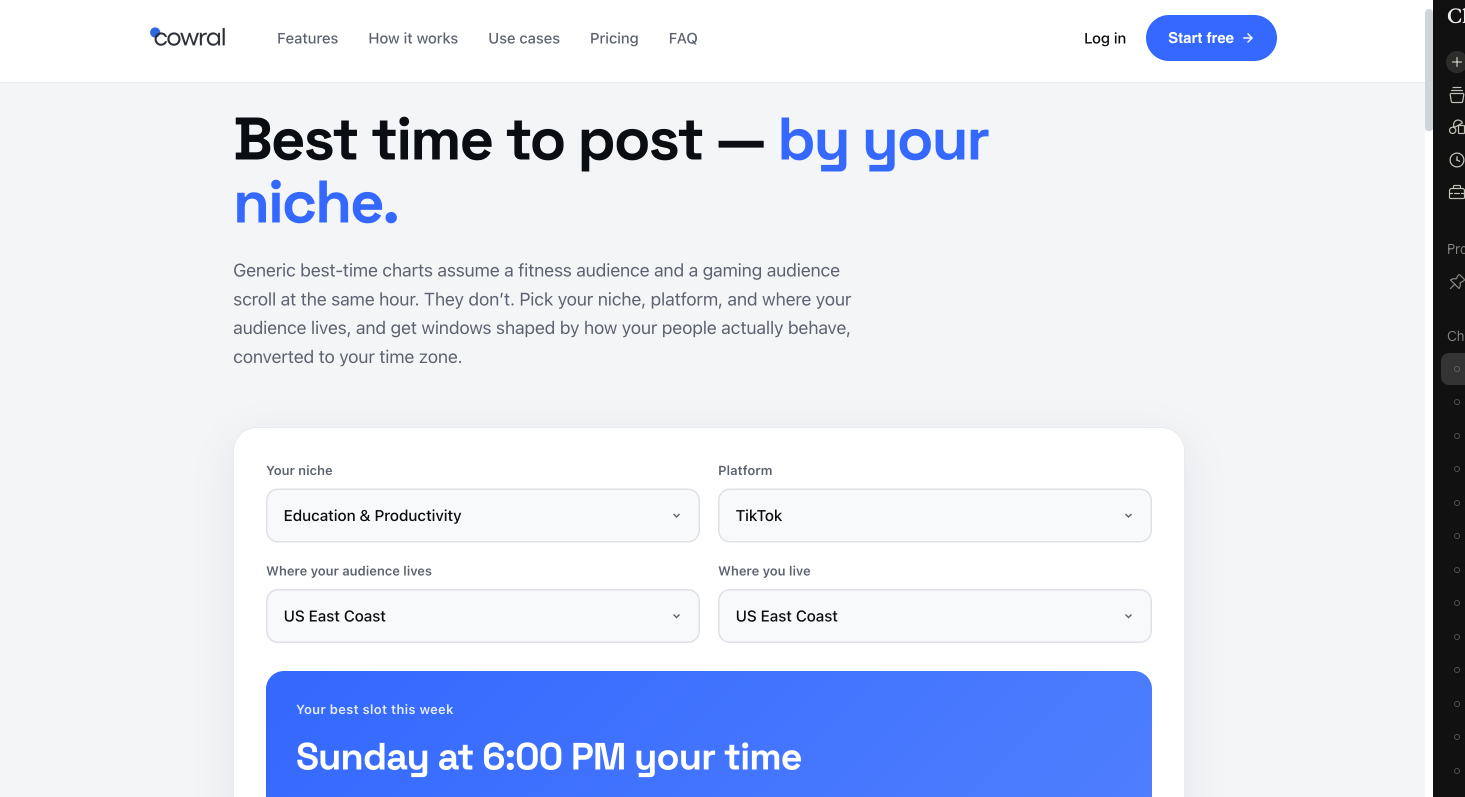
The raw time math is real and in AI’s favor. My old process was roughly 40 minutes per hook. Pure AI was about 2 minutes. The hybrid method I landed on was about 5 to 8 minutes, because I still write and record the final line. Across 30 videos, even the hybrid saved me somewhere north of 15 hours in a month versus doing it all by hand. That is a part-time-job’s worth of time back, and it is the honest headline benefit. Time I could spend on the parts of growth that actually compound, like studying when my specific audience is online instead of agonizing over sentences.
But there are two costs the “look how fast” videos skip. The first is money. The dedicated hook tools run a monthly fee, and the ones that actually score hooks well are not the free ones. The general models cost less per use but you’re paying for a subscription somewhere. Small numbers, but real, and worth naming when the pitch is usually “free.”
The second cost is subtler and I didn’t see it until week three: the time you save on writing, you partly spend back on judging. Ten AI hooks per video means ten decisions instead of one. Reading, comparing, and picking is faster than writing from scratch, but it is not free, and by day 20 the decision fatigue was real. The genuine efficiency win came only when I stopped asking for ten finished hooks and started asking for ten angles, because judging an angle is faster than judging a finished sentence. So the hybrid method wasn’t just better for quality. It was less mentally expensive too.
I nearly published this without mentioning it, then realized leaving it out would be irresponsible, because it caught me off guard and it might catch you.
There is now a real disclosure regime around AI content, and the penalties are not theoretical. As of 2026, the FTC treats AI-involved endorsements under its existing endorsement rules, with per-violation penalties that run into tens of thousands of dollars. The line that matters is not “did you touch AI.” It is whether the thing presenting to the viewer is synthetic.
Here is the distinction as I understand it, and it is genuinely good news for the method this article lands on. Using AI to draft, brainstorm, clean up, or assist while you write your own script and record your own voice is treated as AI-assisted production, and the heavier synthetic-endorsement disclosure does not attach. It’s when the face, the voice, or the persona itself is AI-generated that you cross into territory requiring clear disclosure.
So the hybrid method, AI writes the angle, you write and say the words, sits on the safe side of that line by default. Pure AI hooks read by your own voice on your own face are also fine. Where you’d need to be careful is the fully synthetic route: an AI avatar, a cloned voice, a persona that never existed, presented as if it’s a real person. That is a different article and a different risk profile. If any part of your content is sponsored, the rules stack further, and disclosure is not optional.
None of this changed my verdict. It reinforced it. The method that protects your voice creatively also happens to be the one that keeps you clear of the disclosure problem. Being the human in your own content is not just better content strategy in 2026. It is cleaner legally.
The dead hooks all had the same disease: they were about the topic in general. “Here’s how to do X.” “Three tips for X.” Correct, useful, invisible. The average of a thousand videos about X.
The hooks that worked, whether AI-drafted or hybrid, clustered into a few shapes. This matches the wider testing too, where only four hook patterns reliably scored high in 2026: the Identity Call, the Contrarian Strike, the Open Loop, and the Confession. In my own month:
See the pattern in the pattern? AI nailed the structural hooks (open loop, callout) and fumbled the human ones (the sharp contradiction, the real confession). That line, structural versus human, ended up being the whole lesson. If you want the plain-English version of each formula with examples, I broke them down in three hook formulas that actually stop the scroll.
One cross-platform note, since people always ask: I ran this on TikTok, but the same split holds on Reels and Shorts. The completion-first mechanics are near-identical now, and the 2026 Reels playbook shows the same early-retention pressure. What changes is voice, not the structural-versus-human rule. A hook AI can safely draft for TikTok it can safely draft for Reels. The confession you still have to write yourself, everywhere.
Two things, specifically.
The confession hook, and anything that depends on a real, lived, specific detail. The moment a hook needs to have actually happened to someone, AI is guessing, and viewers can feel the guess even when they can’t name it. The save-rate drop was, I think, mostly this. Competent hooks about nobody in particular.
And the final version of any hook. I’ll take AI’s ten angles all day. I won’t ship AI’s exact words anymore, because shipping the average is how you slowly sound like everyone else. There’s a real cost to that beyond vibes, too. TikTok’s Creator Rewards Program explicitly bars AI-dominated content on originality grounds, demanding work that showcases the creator’s own point of view. The platform is quietly drawing the same line my save rate drew: fine to use AI, not fine to be AI.
You should not take my word for any of this. Your niche, your voice, and your audience will behave differently than mine. So here is the exact protocol, stripped down, so you can run it yourself and trust your own data instead of my anecdote.
Two weeks in you’ll have a feel. A full month gives you data you can actually trust. And whichever way it breaks for you, you’ll stop guessing about it, which is the entire point.
Before you write another hook
Cowral generates hooks and full scripts tuned to your specific niche, then tracks which ones actually grew your account on the Success Dashboard. So your next hook is built on what worked for you, not on a generic list.
Try Cowral free, no card needed →Would I hand AI all my hooks again? No. Would I go back to writing every one from a blank page in forty agonizing minutes? Also no.
The month turned a false question (“AI or me?”) into the real one (“AI for what, me for what?”). The answer I walked away with, and still use:
Let AI write your first ten hooks and none of your final ones. Use it to kill the blank page, to surface angles you’d never reach, to generate the volume that lets you test properly. Then take the pen back for the actual words, especially anything that needs a pulse. AI is a brilliant assistant with no life story, and hooks are where your life story does the work.
The creators who look like they’ve automated everything mostly haven’t. They’ve automated the setup and kept the taste. That’s the whole trick, and it’s the honest version of the “I let AI do it for 30 days” story that the thumbnail promised. It didn’t replace me. It just fired the worst, slowest part of my process and left the part that was actually mine.
If you want a tool that’s built around that split rather than against it, that hands you niche-specific angles and hooks to react to instead of a finished average to copy-paste, that’s more or less the thing we build at Cowral. But tool or no tool, the lesson stands on its own: first ten, not the final one.
Yes, with a real limit. AI is excellent at generating specific, well-structured hooks fast, and it’s especially good at open-loop and callout formats. In a 30-day test, AI hooks held completion rate steady and tripled how much content could be tested. Where it falls short is voice and lived specificity, which is why AI hooks reportedly land around two-thirds of the engagement of top human-written ones. Use it for volume and angles, not for the final wording.
Not automatically, but there are limits worth knowing. Properly labeled AI content isn’t penalized in the feed, and viewers can now filter how much AI content they see. However, TikTok’s Creator Rewards Program bars AI-dominated content on originality grounds, so if monetization matters, the work needs to clearly show your own point of view rather than read as machine-generated average.
The hybrid method beat everything in my test. Instead of asking AI for finished hooks, ask it for angles: “give me ten surprising or contrarian angles on this topic.” Then write the actual hook yourself using the angle it surfaced. This kills the blank page and keeps your voice, and it recovered the save-rate drop I saw when AI wrote hooks start to finish.
It’s close to everything. TikTok’s algorithm weights early retention so heavily that a video holding 80 percent of viewers for three seconds outperforms one holding 60 percent for the full length. You have roughly three seconds, and generic openers lose most viewers inside two. Completion rate, which the hook largely determines, is estimated to drive 40 to 50 percent of the ranking decision.
Because generic is mathematically safe. Given a vague prompt, a model produces the statistical average of its training data, and that average is what every other AI tool also outputs. The fix is tighter, weirder, more specific inputs, plus a human editing pass on the final wording. Broad prompts get broad hooks. Narrow constraints and human taste are what produce something that sounds like you.
Testing in 2026 consistently surfaces four: the Identity Call (naming the exact viewer), the Contrarian Strike (flipping a belief), the Open Loop (opening a curiosity gap), and the Confession (a real, specific admission). AI handles the structural ones (open loop, callout) well and struggles with the human ones (sharp contradiction, genuine confession), which is exactly where your own writing earns its keep.
It depends on what AI actually did. Using AI to draft or brainstorm hooks while you write the final wording and record your own voice is treated as AI-assisted production, which does not trigger the heavier synthetic-endorsement disclosure. You cross into disclosure territory when the face, voice, or persona presented to viewers is itself AI-generated. Sponsored content adds its own separate disclosure requirement on top. When in doubt, check the FTC’s current endorsement guidance, because penalties are real and per-violation.
In time, clearly yes. In my test, the hybrid method saved over 15 hours across a month versus writing every hook by hand. But it isn’t free: the good hook tools carry a monthly fee, and you spend some of the saved writing time on judging the AI’s options instead. Asking for angles rather than finished hooks cuts that judging cost, because evaluating an angle is faster than evaluating a finished sentence.

Olu Sam is an SEO expert and social media content creator who built over 50K followers across his social media pages in less than a year of creating content.
LinkedIn ProfileHow we research and fact-check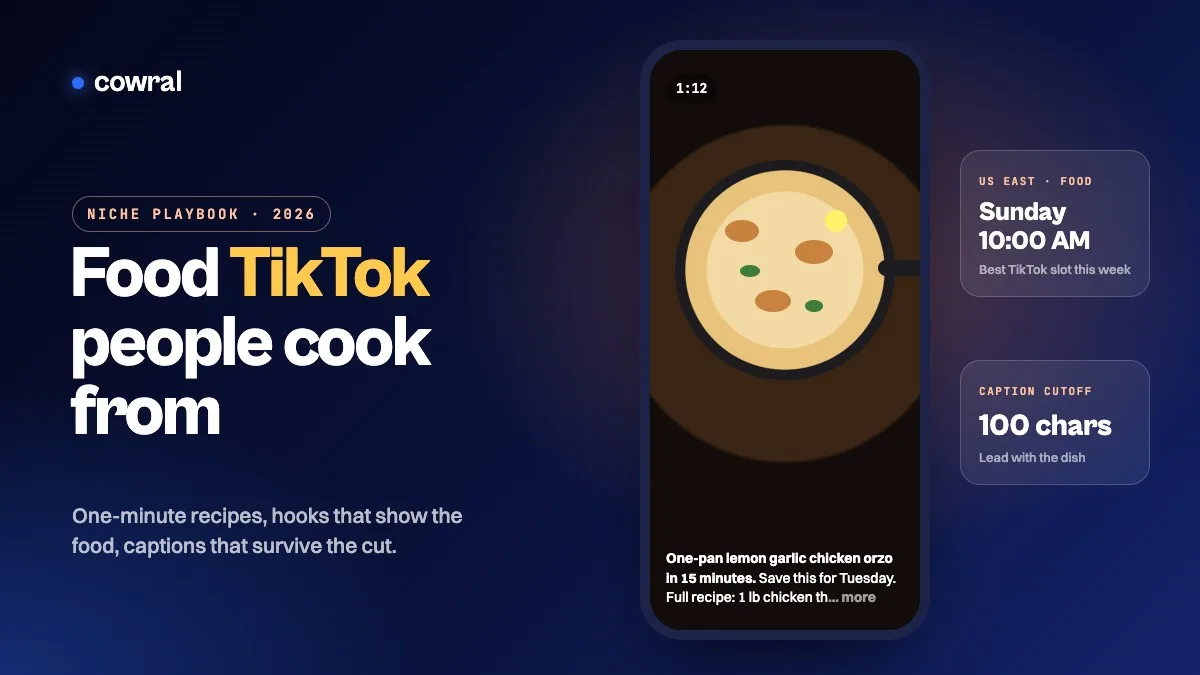 TikTokFood creators on TikTok in 2026: how to grow a recipe account people actually cook fromA 2026 playbook for food creators on TikTok, covering what the Creator Rewards Program pays for, hooks and captions that work for recipes,...
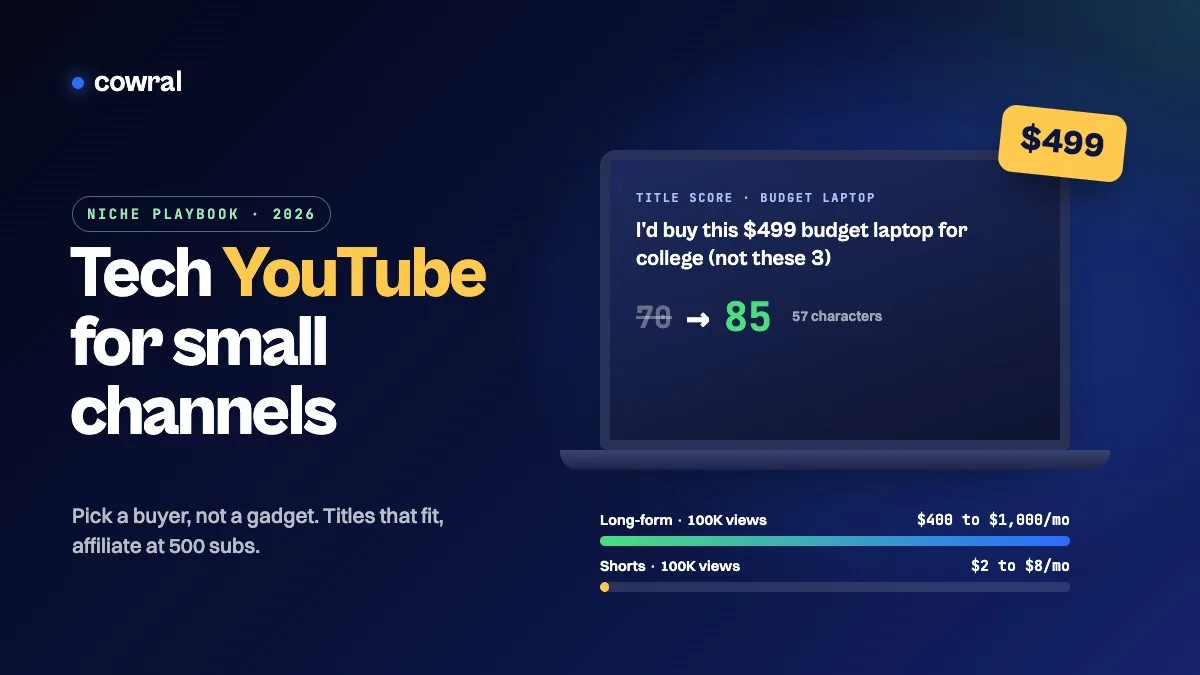 YouTubeTech YouTube in 2026: a channel strategy for small creators who review, explain and buildHow to grow a small tech YouTube channel in 2026, from picking a buyer instead of a gadget and writing titles that don't get cut off to the...
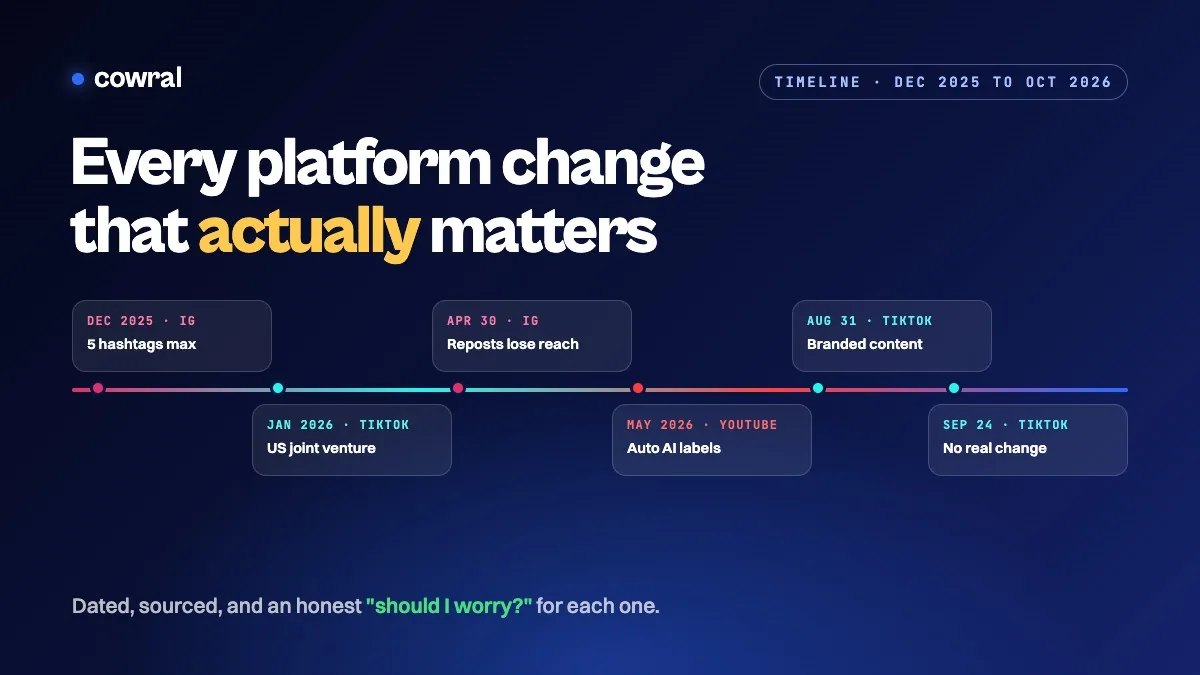 InstagramAlgorithm and policy changes creators need to know in 2026: a dated timelineEvery TikTok, Instagram and YouTube change that actually matters for creators in 2026, in date order, with sources, what each one means for...