10 free tools. Zero signups. Your files never leave your browser.Open the Viral Lab →
Most niche AI creator tools are built on top of the same frontier models ChatGPT runs. When the intelligence underneath is shared, "which is smarter" is the wrong question. The real dividing line is data access.
Key takeaways
We build a niche AI tool for creators, so let me start by arguing against my own category, because the pitch you usually hear is dishonest and you should know why.
The standard pitch goes: ChatGPT is generic, our tool is specialized, specialized beats generic, so pay us. It sounds reasonable. It’s also wrong for a large chunk of what creators actually do in a week. For a lot of that work, ChatGPT is genuinely as good, sometimes better, and you do not need a second subscription to rewrite a caption or brainstorm thirty video ideas.
But there is a specific and predictable set of jobs where ChatGPT falls apart, and the reason it falls apart has almost nothing to do with how smart the model is. Nearly every article on this topic frames it as a quality contest, ChatGPT versus tool X, may the better writer win. That framing is the mistake, and it’s why most of these comparisons are useless. Once you see the actual line, the decision about what to pay for gets simple, and it usually saves you money rather than costing you more.
This is the deep version. We’ll go tool by tool, price by price, with the receipts.
On this page: the wrapper problem · the real dividing line · where ChatGPT wins · where it loses · the tool landscape, honestly · what your stack should cost · the authenticity problem that changes everything · the decision in one question · FAQs
A large share of AI creator tools are, underneath the interface, a prompt and a nice dashboard sitting on top of a model you could rent yourself.
That’s not an accusation, it’s an architecture. Many tools call the same frontier models everyone else calls, add a system prompt, some formatting, a workflow, and charge monthly. Some of them are absolutely worth it. But you should know what you’re buying before you buy it, because if a tool’s entire advantage is that someone wrote a better prompt than you would have, you can write that prompt once, save it, and stop paying forever.
The tools that genuinely earn their price add something the raw model cannot get on its own. In practice that’s one of three things: proprietary data, a live connection to a platform, or a workflow that saves real hours instead of seconds. Everything else is a convenience you’re renting.
You can see the honest version of this hiding in plain sight. When creator tools get compared head to head, the smart ones are described not as “the AI is better” but as owning a job the general model structurally can’t do well: a point tool solves one specific problem, ChatGPT helps you write, OpusClip cuts your clips, vidIQ handles keywords and optimization, and the issue is that none of them automatically connect to the full strategy. Notice that the differentiation is never intelligence. It’s the specific data or workflow each one owns.
So the first cut is simple. If your complaint about ChatGPT is “the output sounds generic,” that’s mostly a prompt-and-editing problem, and a subscription may or may not fix it. If your complaint is “it doesn’t know what happened in my niche this week, or what worked on my own account,” no amount of prompting fixes that, and that’s the gap worth paying to close.
Here’s the reframe the whole article rests on, and the deep-research backing that makes it more than a slogan.
ChatGPT is a brilliant collaborator who has never seen your account. And that’s not a temporary limitation waiting for the next model. It’s structural. Consider what the current product actually cannot see:
It has no access to your internal data, it cannot see your tracker history, your past tests, or your own performance, so every question starts from zero. It has a training cutoff, so anything recent exists for the model only if a tool call retrieves it. Its data analysis runs in a sandboxed environment with no direct database or warehouse connection and a memory that resets when the session ends. Even when you connect it to your analytics, the honest workaround is to export a CSV and attach it by hand, which means it’s a snapshot fetched manually every time, not a live view.
Read those together and a pattern appears. Every one of ChatGPT’s creator-relevant weaknesses is the same weakness: it cannot see your specific, current reality on its own. It can reason about that reality beautifully once you paste it in. It just can’t go get it.
Niche creator tools, the good ones, aren’t smarter than that collaborator. They’re connected. That’s the entire product. A trend tool watches your niche’s velocity in real time. An analytics tool reads your retention curves directly. That connection, not intelligence, is what you’re renting.
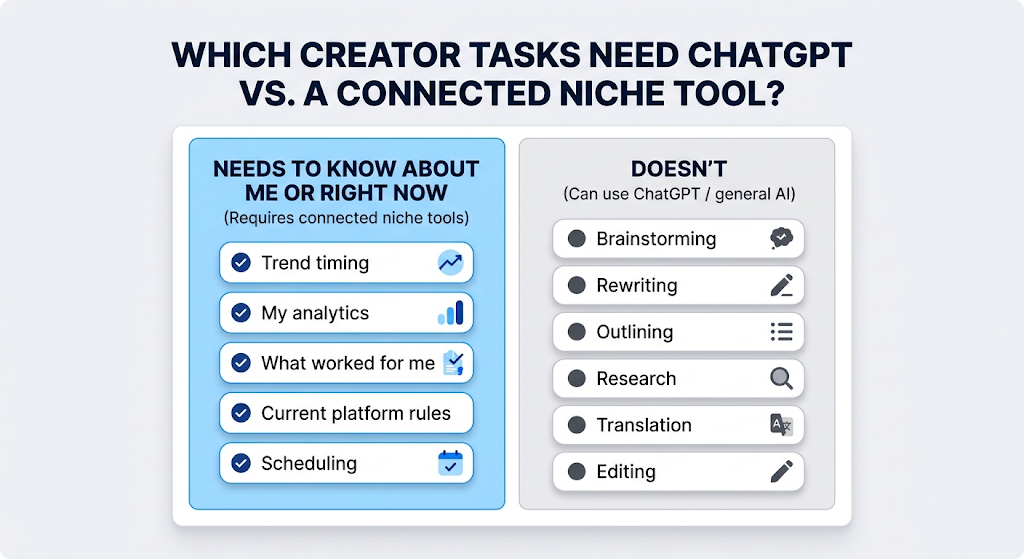
So the useful question was never “which is better.” It’s this: does this task require knowing something specific about me, or about right now?
If no, use ChatGPT. Almost always, and usually cheaply.
If yes, ChatGPT is structurally the wrong instrument no matter how good the model gets. A model that scores higher on every reasoning benchmark still cannot see a dashboard it has no connection to. That distinction also explains the confusing lived experience creators report, where ChatGPT feels miraculous for some parts of the job and uselessly vague for others. It isn’t inconsistent. It’s blind in exactly one direction, and the tasks that need sight are the ones where it disappoints.
Specific, because vague advice is what built everyone’s twelve-subscription stack. These are jobs where reaching for a niche tool is usually waste.
Ideation at volume. Forty title variations, thirty angles on a topic, a list of every objection your audience might raise. Raw idea generation is a general-intelligence task and ChatGPT is very good at it.
Rewriting and reformatting. Turning a long caption short, a script into a carousel, a newsletter section into a post. This is transformation of text you already have, which needs no external data at all.
Outlining and structure. Ordering an argument, finding the hole in it, spotting where a script sags. Strong general reasoning beats a rigid template here.
Research and synthesis. Understanding a topic before you make content about it. Paid tiers include web browsing and deep research, so it can pull current information into a summary, with the real caveat we’ll get to about source accuracy.
Editing your own writing. Tightening, cutting, catching the dead sentence. The free tier handles this fine.
Translation and localization. Genuinely excellent, and almost nobody buys a separate tool for it.
One-off technical friction. A spreadsheet formula, a thumbnail dimension, a caption file that won’t cooperate.
Add those up honestly and it’s a large share of a creator’s actual week, all running on a general tool. And the price of entry is low. As of 2026 the free tier gives real access with usage caps and, in the US, ads since February. The $8 Go tier mostly buys volume rather than new capability, staying on the lighter default model. And Plus at $20 is where the flagship reasoning model, deep research, and the full feature set open up. Above that, Pro runs $100 or $200 a month for heavy power users, which almost no individual creator needs. For most working creators, free-or-Plus covers the entire “general work” column.
One underrated point: memory and custom instructions. Set your niche, audience, and voice rules once, and the “ChatGPT sounds robotic” complaint shrinks a lot. Most people saying that never configured it, and are comparing a stranger’s default to a tool someone else onboarded properly.
Same pattern every time. Each of these fails for the identical structural reason.
Knowing what’s trending in your niche right now. ChatGPT can browse, but it cannot watch the velocity of a specific format inside a specific niche across a specific platform over the last seventy-two hours. Ask it what’s trending and you get either a stale generality or a summary of an article someone wrote last month. Trend detection is a live-data pipeline wearing an AI costume, which is exactly why tools like vidIQ exist and sell.
Reading your analytics. It has no live line to your retention curves, your follower-versus-stranger split, or which of your videos your existing audience actually finished. You can paste a screenshot and it will reason well about it, but that’s you doing the data-fetching by hand, every single time, forever. The moment you want ongoing, connected analysis, the wall is the absence of a warehouse connection and a bound knowledge base, not the model’s intelligence.
Knowing what worked for you specifically. A tool with your history can say your question hooks beat your statement hooks by a measurable margin. ChatGPT can only tell you what tends to work for people in general, which is the generic advice you already have.
Current platform mechanics. Not the theory, the live rules. Which lengths are favored this month, how a new feature is actually behaving, what the originality thresholds are. This changes faster than any training cutoff, and it’s why our breakdown of the 2026 TikTok algorithm and the 2026 Reels playbook exist at all, because most advice online describes platforms that stopped existing months ago.
Scheduling, publishing, cross-posting. Obvious, but worth stating. It’s a conversation, not an integration.
Repeatable multi-platform pipelines. You can prompt your way through one idea to five platform versions once. Doing it every week by hand in a chat window is exactly the kind of task a repurposing workflow earns its keep on, in recovered hours rather than better sentences.
Source-grounded factual claims. This one’s sharper than most creators realize. One analysis found roughly 14 percent of ChatGPT citations link to real sources, which means if your content depends on accurate references, you become the manual fact-checking layer by default. Fine for a brainstorm, dangerous for a claims-heavy post.
The common thread, again: ChatGPT isn’t losing these on intelligence. It’s losing them on access. That’s the only gap that justifies a second subscription, and it’s a real one.
Cowral watches what’s rising inside your specific niche, reads against your own account context, and drafts in your voice. The part a general model structurally can’t do.
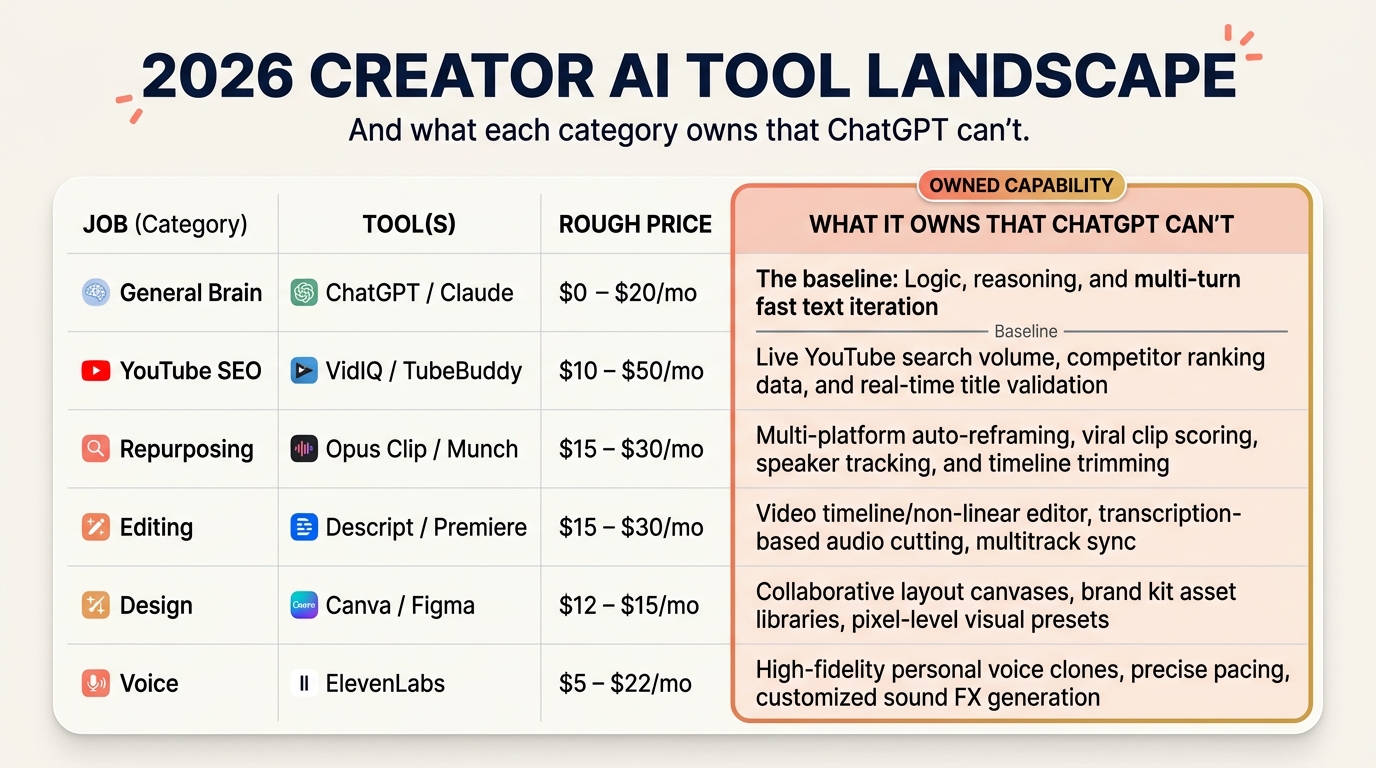
Try Cowral free (no card) →Deep research means naming names, so here’s the actual 2026 creator-tool map and where each sits relative to ChatGPT. The consistent expert verdict is that there is no single best tool, it depends on your content type, and the right approach is a stack that covers your full workflow.
The general brains: ChatGPT and Claude. For creators, the frequently cited split is Claude for long-form and brand-voice matching, ChatGPT for most everything else. Either one is your writing and thinking layer.
YouTube SEO and coaching: vidIQ (from around $7.50 to $16 a month) and TubeBuddy (from around $5 a month). These own keyword, optimization, and channel-coaching data that ChatGPT simply doesn’t have.
Repurposing long video to short: Opus Clip (around $15 to $29 a month) and Submagic (from around $12). They auto-clip and score for virality, a workflow, not a chat.
Editing: Descript (around $19 to $30) for transcript-based editing, CapCut for short-form. Different job entirely from a language model.
Design and thumbnails: Canva AI (around $15). Again, not something you’d ask ChatGPT to do well.
Voice: ElevenLabs (from around $5 to $22).
Look at that list and the pattern from the dividing-line section holds perfectly. Every tool that survives next to ChatGPT does so because it owns data or a workflow the general model can’t touch: platform SEO data, clip-scoring pipelines, transcript-based editing, design canvases. None of them win on raw intelligence, and none of them need to. The ones you should be suspicious of are the pure text tools whose only claim is “better writing,” because that’s the one thing the general models already do for eight to twenty dollars.
The guru version of this advice is a twelve-tool stack with an affiliate link on every entry. We wrote separately about how that affiliate incentive quietly warps every tool recommendation you read, so treat any list with a payout behind it accordingly.
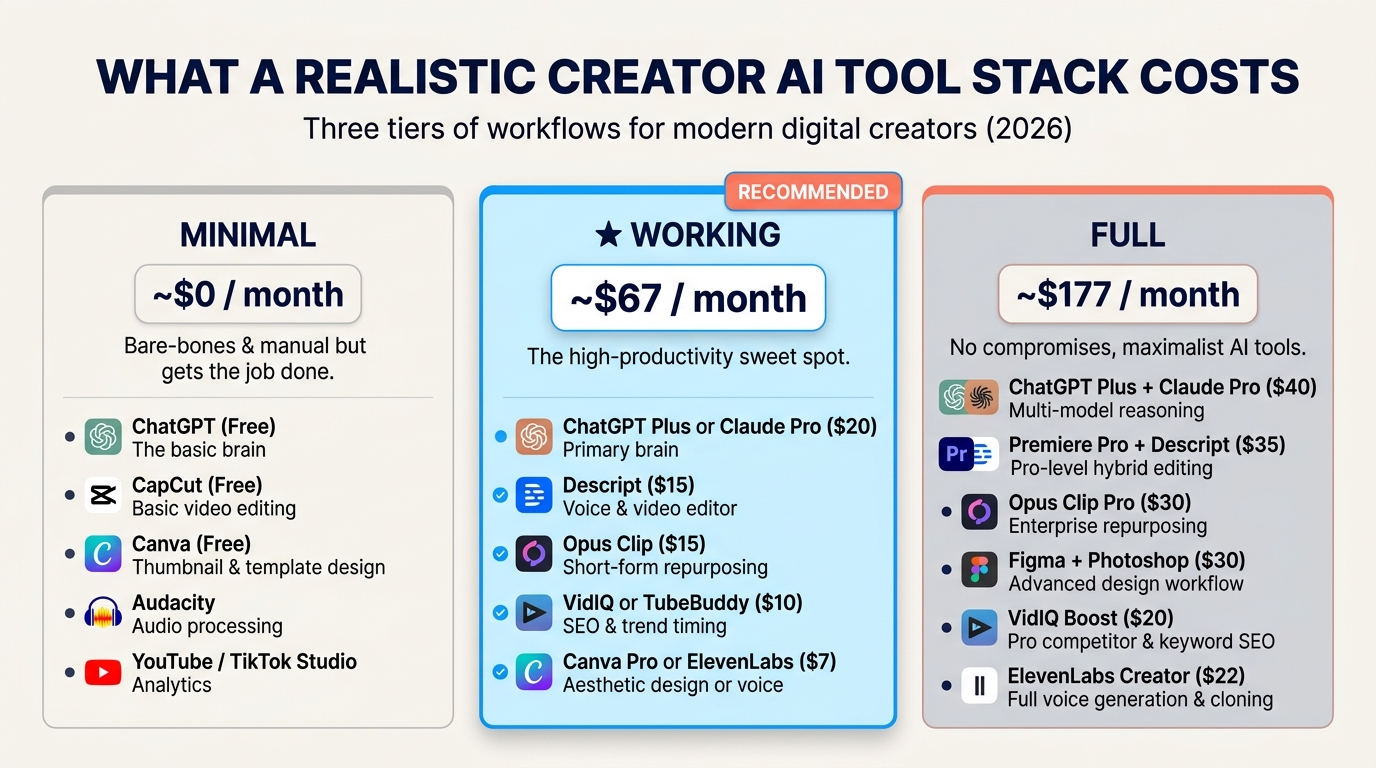
The realistic number is much smaller. One honest 2026 breakdown lays out three tiers: a minimal stack at essentially $0 using free tiers, a working stack at around $67 a month, and a full stack at around $177, and the single biggest waste pattern is stacking tools with overlapping jobs so you end up with three half-used logins instead of one that works.
A sane structure for a solo creator:
One general brain. ChatGPT Plus at $20, or the free tier starting out. Writing, thinking, research, rewriting. Configure the memory before you judge it.
One connected tool. Something that sees what a general model can’t: your platform data, your niche’s live trends, your own performance history. This is the only category where paying twice for AI genuinely makes sense, and yes, it’s the category we build in, so weigh that as you like.
One visual tool. Design or video, depending on what you publish.
Optionally one automation or repurposing layer if you actually repeat a weekly pipeline. If you don’t, skip it. Tools bought in anticipation of a workflow you haven’t built yet are the most abandoned subscription in the category.
That’s three or four line items, landing near that $67 working-stack number, not twelve. If your current setup has nine, open your billing page and find the two you last opened in April. It isn’t a moral failing. It’s just what tool sprawl does when every recommendation carries a commission.
Here’s the part the original version of this debate completely missed, and the deep 2026 data forces onto the table. Even if you pick the perfect tool, there’s a failure mode sitting underneath all of it that no subscription solves.
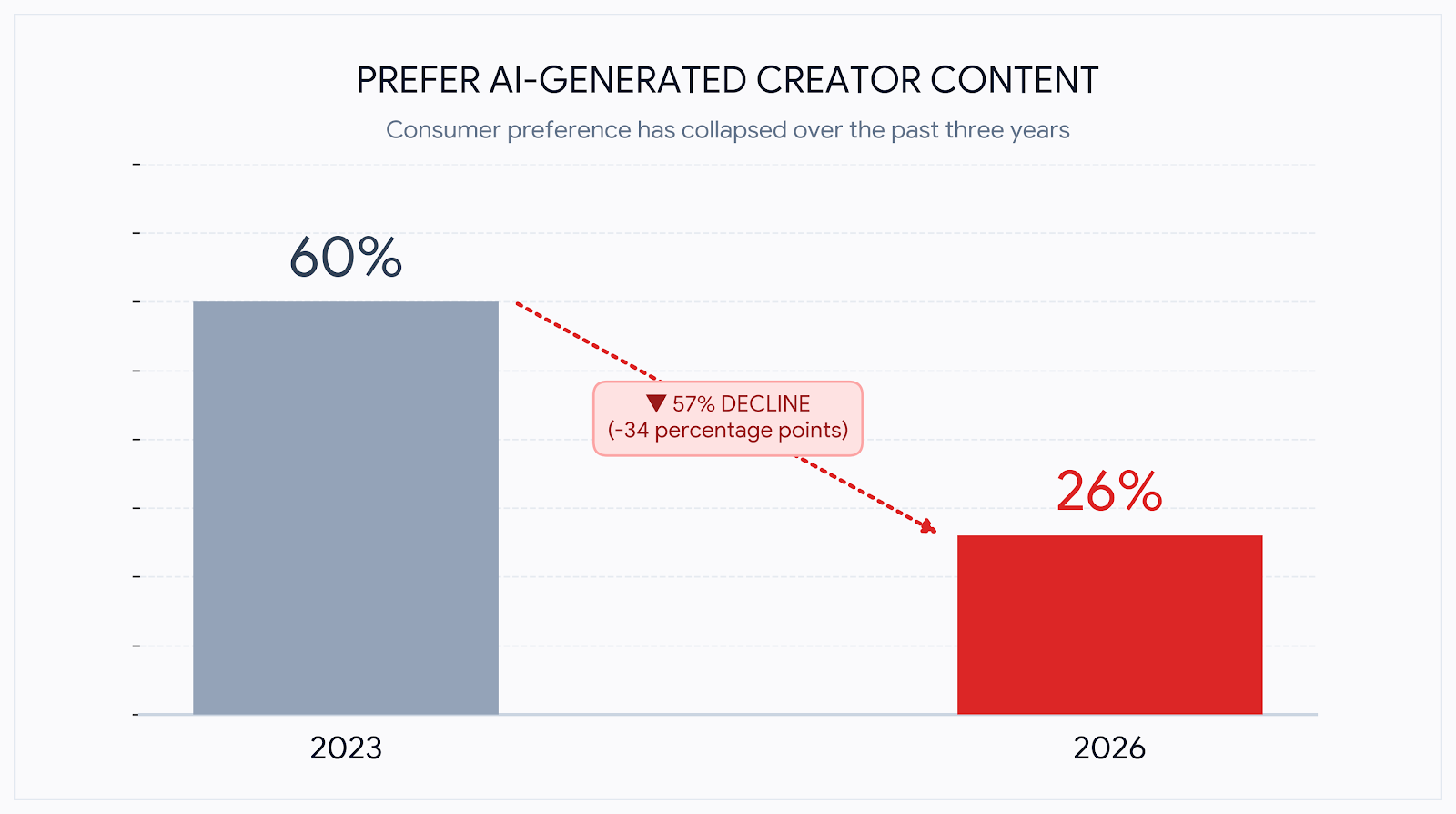
Audiences have turned on content that reads as AI, and the shift is not subtle. Only 26 percent of consumers now prefer AI-generated creator content to traditional creator content, down from 60 percent in 2023. The number roughly halved in two years, in the wrong direction. On the brand side it’s starker: in one survey of 8,000 consumers, only 7 percent said visible AI-generated marketing made them trust a brand more, while 31 percent said it made them trust the brand less, a four-to-one gap.
And the mechanism matters for the tooling choice. The thing audiences penalize isn’t “used AI somewhere.” It’s content that reads as an average of the internet: generically plausible, no point of view, a voice that doesn’t sound like it belongs to an actual person. That is precisely the output you get when you let any general model, ChatGPT very much included, write the final words unsupervised, because producing the statistical average is the safest thing a model can do.
So the authenticity data doesn’t just add a caveat. It reorganizes the whole question. The risk was never picking the wrong AI. It’s shipping anything, from any tool, that sounds like a machine shipped it. Which means the correct use of every tool on this page, ChatGPT and niche tools alike, is the same: use them to clear the runway, then put your own voice, your own specific detail, your own actual opinion into the final product before it goes out. The tools that survive 2026 are the ones that help you sound more like yourself, not less.
This connects to something we’ve argued before: under current distribution your existing followers gate everything, so a weak, forgettable post costs you more than it used to. AI makes producing more trivially easy. Producing more was never the goal.
Forget the feature grids. Before any creator task, ask:
Does this need to know something about me, or about right now?
No. Use ChatGPT. Ideation, rewriting, outlining, research, editing, translation, one-off problems. Configure it and stop shopping. For a lot of creators this is the honest end of the article, and the money you were about to spend on a second AI writing subscription is better spent on a microphone.
Yes. A general model is structurally the wrong tool, and prompting won’t close the gap. Live niche trends, your analytics, your own performance history, current platform mechanics, scheduling, repurposing pipelines. This is where a connected tool earns its price, and where we’d argue for Cowral, which detects your niche, watches what’s rising inside it specifically rather than globally, and drafts against your own account context. The free tier covers that without a card, so you can test the premise before paying anything.
Both, honestly. Most working creators land here: one general brain plus one connected tool. That’s a sane place to be. What isn’t sane is nine subscriptions and a spreadsheet to track them.
The tool companies want this argued as a quality war because quality wars are unfalsifiable and they sell subscriptions. It was never one. ChatGPT is a very smart collaborator who has never seen your dashboard, and the entire decision is whether the job in front of you needs the dashboard. Most days it doesn’t. Some days it completely does. And on every day, whatever tool you used, the last pass has to sound like you. Pay accordingly.
For the days the answer is “yes”
When the task needs to know about your niche, your timing, and your own performance, a general model can’t help.
That’s exactly what Cowral is for: niche detection, live trends inside your category, and hooks drafted against your own account. Free to start, no card.
For general work, largely yes. Brainstorming, rewriting, outlining, research, editing, and translation all run well on ChatGPT, and paying separately for those is usually waste. It cannot replace tools that connect to live platform data or your own analytics, because that’s an access limitation, not an intelligence one. ChatGPT cannot see your dashboard, your niche’s current trends, or your own past performance, and no prompt fixes a missing data connection.
For most working creators, yes. At $20 a month, Plus opens up the flagship reasoning model, deep research, and the full feature set with no ads. The free tier is genuinely usable for light work but caps usage and shows ads in the US. The $8 Go tier mostly raises volume while staying on the lighter model, and the $100-to-$200 Pro tiers are overkill for nearly every individual creator.
Two reasons. It has no data about your niche’s current activity or your own results, so it defaults to what’s broadly true. And most people never configure memory or custom instructions, so it answers as a stranger. Setting your niche, audience, and voice rules fixes a surprising amount of the generic problem for free. Beyond that, the fix is to write the final words yourself, because producing the statistical average is what a model does by default.
Some are. If a tool’s only advantage is a better prompt, you can write that prompt yourself once and stop paying. The ones worth money add something the raw model can’t get alone: proprietary data, a live platform connection, or a workflow that saves hours rather than seconds. Before subscribing, ask which of those three a given tool actually provides. If the answer is “none, but the writing is nicer,” keep your money.
Usually three to five, and most creators over-buy. A workable stack is one general model for thinking and writing, one connected tool that sees data the general model can’t, one visual tool, and optionally one automation or repurposing layer if you genuinely repeat a weekly pipeline. Realistic cost lands around $67 a month for a working stack. Overlapping subscriptions are the most common waste.
It can, and the 2026 data is blunt about it. Consumer preference for AI-generated creator content fell to 26 percent from 60 percent in 2023, and visible AI marketing makes far more people trust a brand less than more. The penalty falls on content that reads as a generic average with no real point of view. Use any AI tool to clear the runway, then put your own voice and specific detail into the final version. The goal is to sound more like yourself, not less.
A dedicated trend tool, without much question. ChatGPT can browse the web but cannot monitor the live velocity of formats inside your specific niche, so asking it what’s trending returns stale generalities. Trend detection is a real-time data problem, which is exactly the kind of connected capability that justifies a niche tool over the general model.

Olu Sam is an SEO expert and social media content creator who built over 50K followers across his social media pages in less than a year of creating content.
LinkedIn ProfileHow we research and fact-check TikTokFood creators on TikTok in 2026: how to grow a recipe account people actually cook fromA 2026 playbook for food creators on TikTok, covering what the Creator Rewards Program pays for, hooks and captions that work for recipes,...
 YouTubeTech YouTube in 2026: a channel strategy for small creators who review, explain and buildHow to grow a small tech YouTube channel in 2026, from picking a buyer instead of a gadget and writing titles that don't get cut off to the...
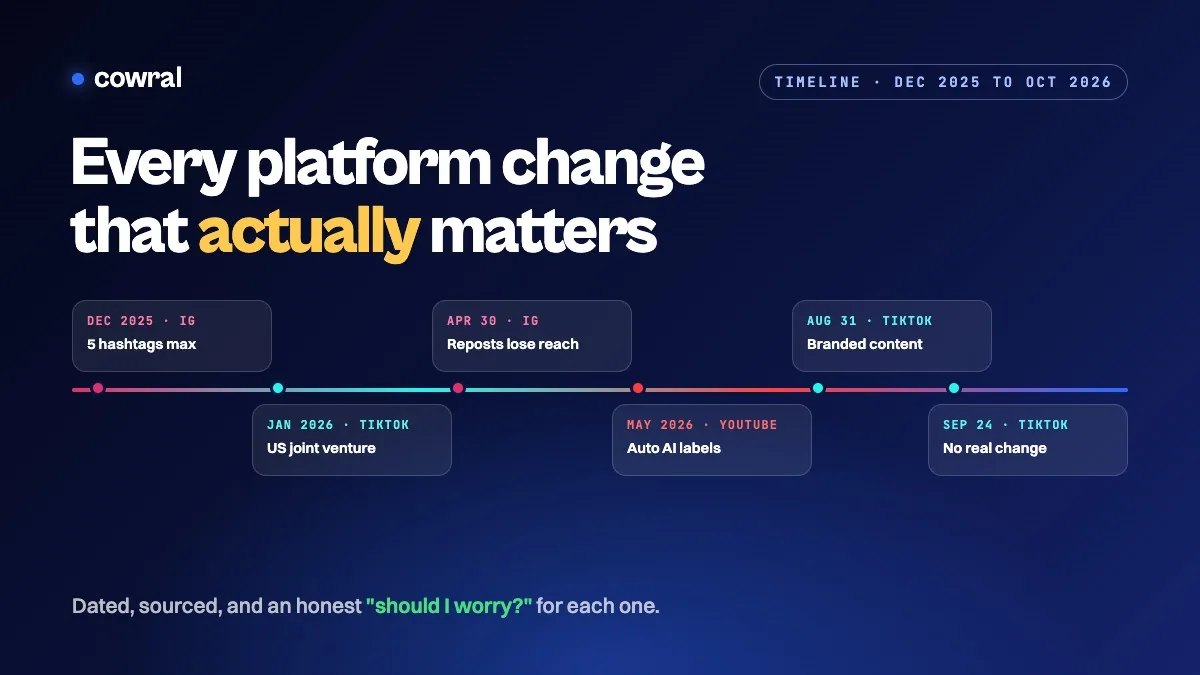 InstagramAlgorithm and policy changes creators need to know in 2026: a dated timelineEvery TikTok, Instagram and YouTube change that actually matters for creators in 2026, in date order, with sources, what each one means for...