10 free tools. Zero signups. Your files never leave your browser.Open the Viral Lab →
AI saves creators hours, but some jobs it quietly makes worse. Where to keep it out of your content, what YouTube, TikTok and Instagram actually say, and a quick check before you open ChatGPT.
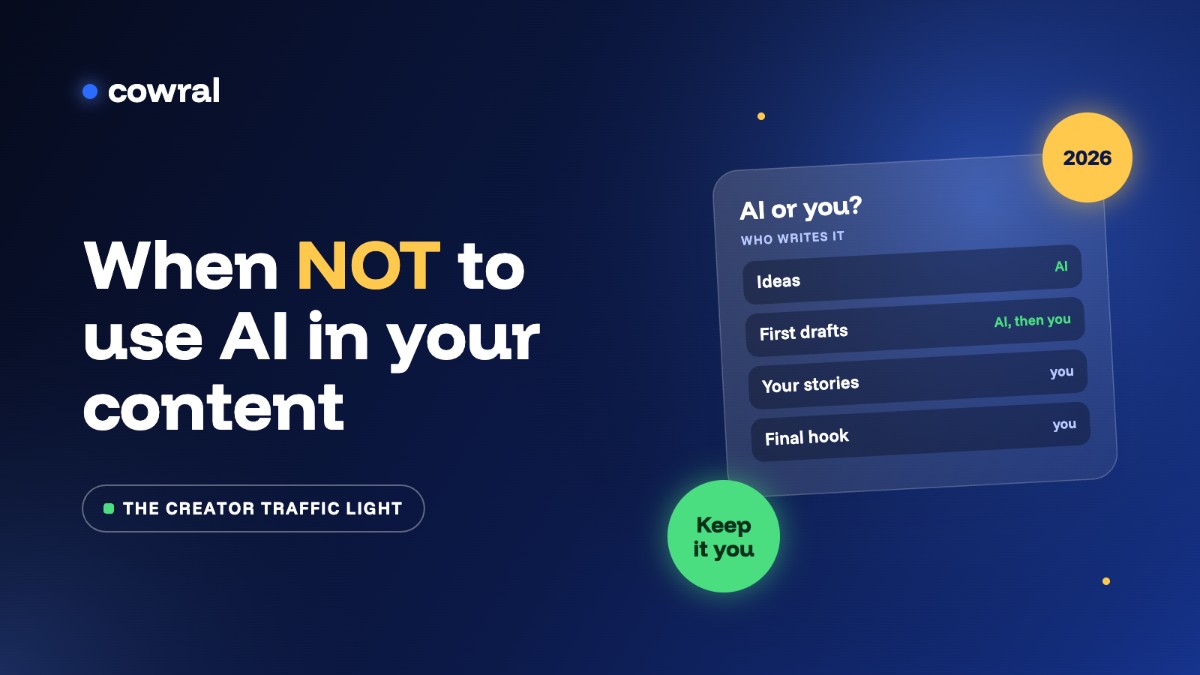
We make an AI tool for creators, so you’d be forgiven for expecting this to end with “use AI for everything”. It doesn’t.
AI is very good at some parts of making content. It’ll give you twenty angles on a topic while you’re stuck in traffic on the way home, turn one YouTube script into a TikTok, a Reel and a carousel, and knock out a video description you’d otherwise put off for a week. But there are jobs where it makes the work worse, a few where it can get you in trouble with a platform, and one big one where it slowly makes your account sound like every other account in your niche.
This is a guide to where we’d keep AI out, what the platforms actually say in 2026 (it’s calmer than the rumors), where AI genuinely pulls its weight, and a short check to run before you hand it a task.
Key takeaways
Every few weeks a new rumor goes round. YouTube is demonetizing AI channels. Instagram hides anything written with ChatGPT. Most of it is half true at best.
YouTube updated its Partner Program guidelines in July 2025 to spell out that “inauthentic” content can’t earn money. That means mass-produced or repetitive uploads: the same slideshow template with a synthetic voice, uploaded hundreds of times with the topic swapped. YouTube’s creator liaison called it a minor update, and it wasn’t aimed at creators who use AI as a helper. Separately, YouTube asks you to answer Yes to the “AI use” question in YouTube Studio for realistic AI content, like a real person appearing to say something they never said, or a realistic scene that never happened. YouTube also says it may add a label itself if its systems detect AI, and that disclosing doesn’t limit your audience or your monetization.
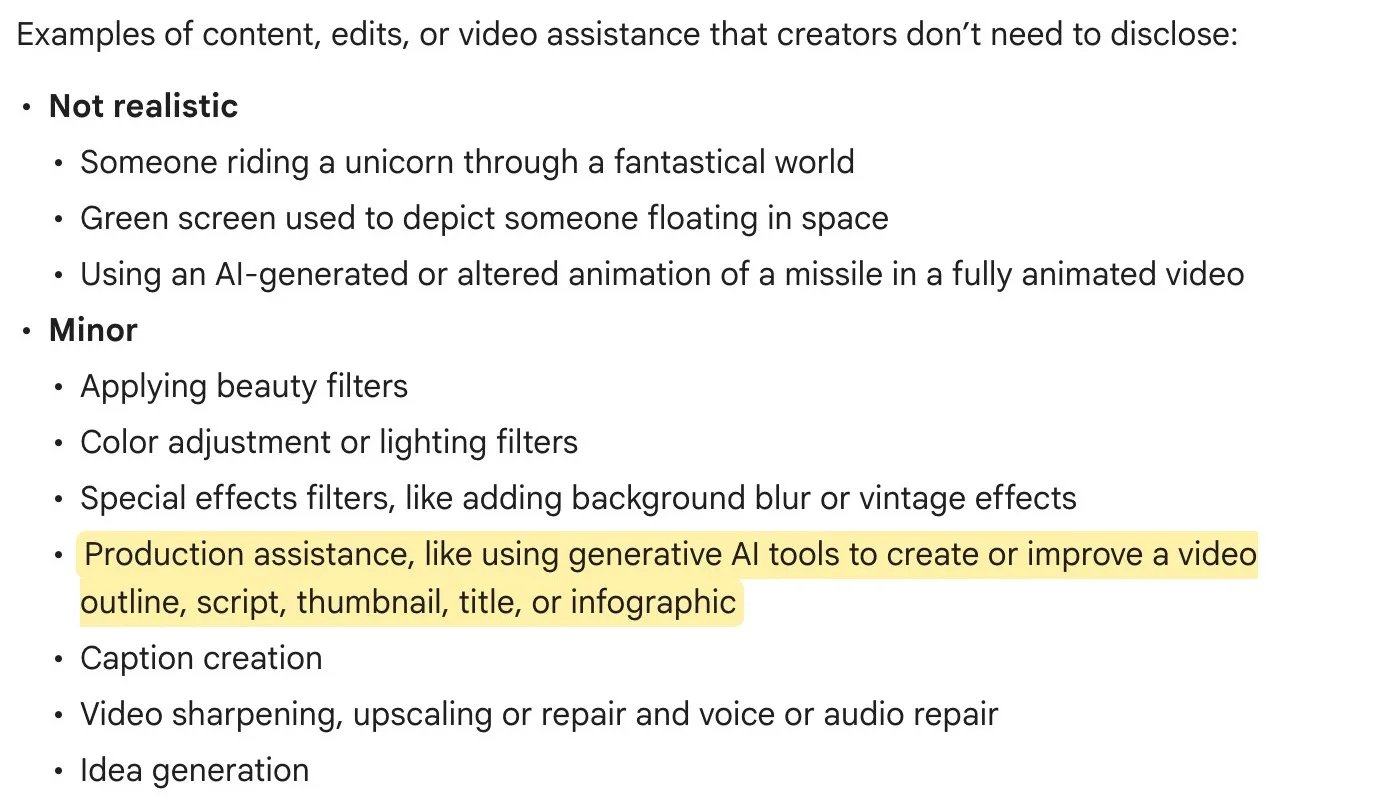
What YouTube says doesn't need a label
TikTok asks you to label realistic AI-generated content and has an “AI-generated content” toggle when you post.
Instagram and Facebook show an “AI info” label on content Meta detects as AI-made or that you mark yourself. Instagram also ranks original content above reposts, and widened that across the whole app in 2026. That’s aimed at recycled content in general, not AI specifically, but AI makes recycling very easy.
Read together, the rules point one way. Using AI to help you make something is fine. Using it to fake something, or to flood a platform with near-identical uploads, is where the trouble starts.
The video about the day you resigned, or what your first brand deal actually paid, or the month you nearly gave up. People follow you for these, and they work because of details only you have: the exact dollar amount, what your manager said, the fact that you were eating a drive-thru burrito in the car when the email came. Ask AI to write the story and you get a version that could belong to anyone. It can help tidy the structure after you’ve told it. That’s about all.
If you’ve got a strong take on something in your niche, write or record it in your own words first. AI is built to be balanced and inoffensive, so it sands down exactly the edges that make a take worth hearing. Afterwards, it’s actually useful for poking holes in your argument. Just not as the starting point.
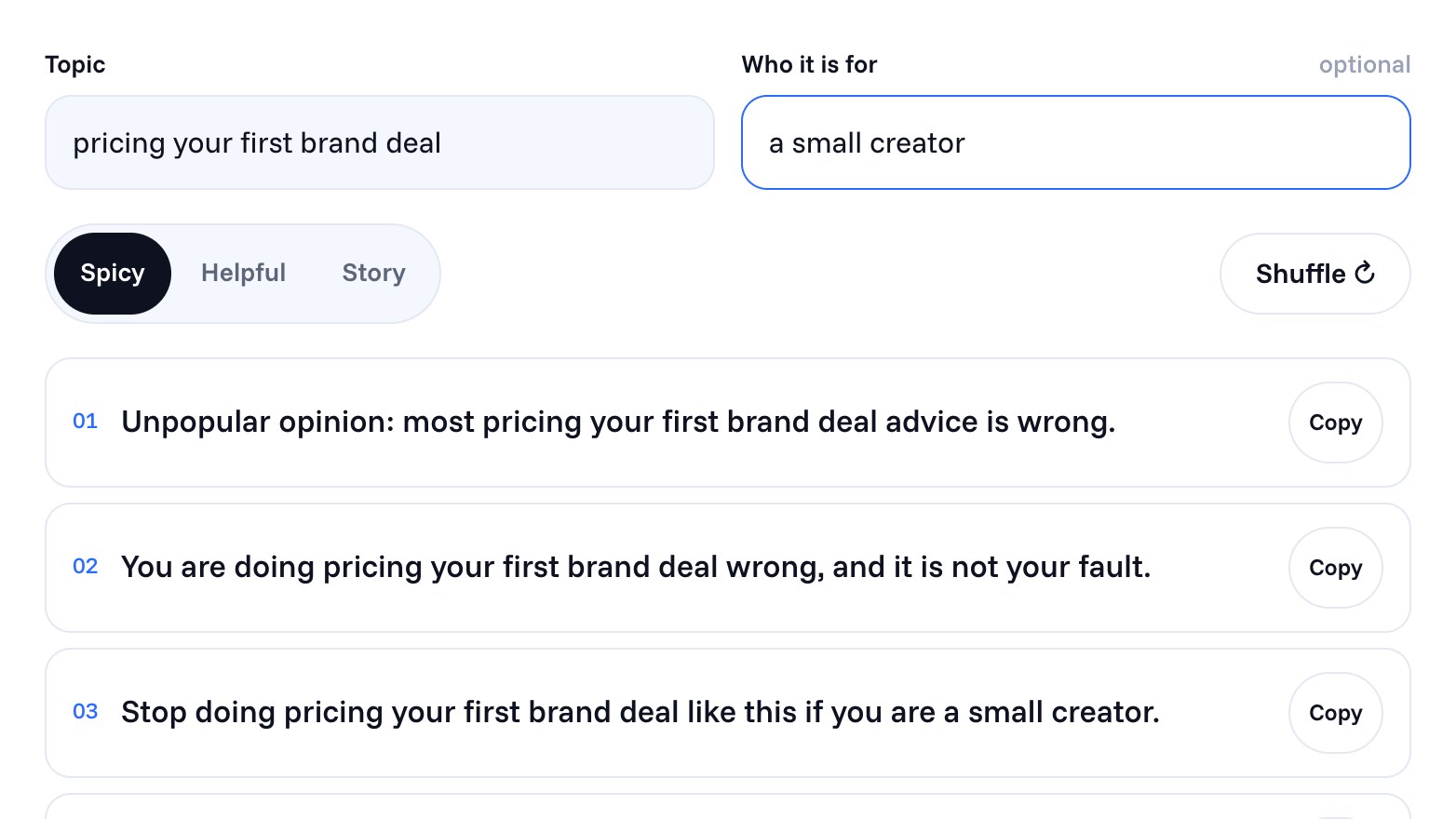
Our 30-day AI hooks experiment ended with a rule we still use: AI should write your first ten hooks and none of your final ones. It’s brilliant at volume. The opening people really stop for usually leans on your voice or a detail only you know. Generate options, then rewrite the winner yourself.
AI tools will state wrong numbers with a straight face. Old payout rates, platform rules that changed last year, stats nobody can source. If your video says TikTok pays a certain amount per 1,000 views and it’s wrong, your comments will let you know, and it’s your name on it, not the tool’s. Use AI to work out what you need to check, then check it with the platform’s own help pages or announcements.
A two-minute fact check
For every number in your script, ask where it came from. If you can’t open the original page in under two minutes, cut the number or say it’s an estimate.
This one gets overlooked. AI tools are mostly trained on standard English from a handful of countries. Ask one to write in Southern slang or the way your group chat actually talks and you’ll usually get something that sounds like an outsider doing an impression. Ask it what rent really costs in Austin or how people actually split a bill in Chicago and it’ll give you a confident, slightly wrong average.
Read your auto-captions
Auto-captions trip on the same things: unusual names, street names, brand names, food, and anything in Spanglish or regional slang. Read them through before you post, because a mangled caption is the first thing a local viewer notices.
If your audience is local, the way you actually talk is part of why they watch. Don’t let a tool translate you into generic internet English.
A realistic clip of a real person saying or doing something they didn’t is the content platforms most want labeled, and in some cases won’t allow at all. Even as a joke, it can mislead people and get the video taken down. Your own voice is a different case. YouTube says cloning it for a voiceover doesn’t need disclosure. Other people’s faces and voices are where we’d stop.
Comments and DMs are where people decide you’re a real person. Pasted AI replies are easy to spot: too long, too polite, and oddly similar to each other. A two-word reply that’s clearly you beats a perfect paragraph that clearly isn’t. If there are too many to answer, answer fewer.
None of this means avoiding it. These are the jobs where AI saves real time and costs you nothing:
For which tool suits which job, our comparison of ChatGPT vs niche AI tools for creators goes through it task by task.
| Task | Light | How to use AI, if at all |
|---|---|---|
| Brainstorming ideas | Green | Ask for lots, keep a few |
| Outlines | Green | Turn your notes into a structure |
| Repurposing for other apps | Green | Draft versions, then rewrite each opening |
| Captions, descriptions, tags | Green | First draft, plus one line of your own |
| Admin and emails | Green | Draft and send after a read-through |
| Script first drafts | Amber | Say it out loud and rewrite in your voice |
| Hook and title options | Amber | Generate many, write the final one yourself |
| Research | Amber | Use it to find what to check, then check the source |
| Regional slang and local detail | Amber | Write it yourself, use AI only for spelling and structure |
| Personal stories | Red | Tell it yourself |
| Opinions and hot takes | Red | Your words first, AI only to stress-test |
| Replies to followers | Red | Answer yourself, even briefly |
| Realistic fakes of real people | Red | Don’t, and label any realistic AI footage you use |
If all three come back clean, let it help.
A lot of creators worry about being “caught” by AI detectors. We’d spend less energy on that. Text detectors are unreliable, and as far as we know none of the big platforms has said it ranks posts down just because AI helped write them. What audiences do notice is sameness: the same phrases, the same safe opinions, the same structure every time. The fix for that isn’t a tool that disguises AI text. It’s putting more of you into the work.
We built Cowral for the green-light jobs. It looks at your niche and what’s moving this week, suggests ideas and hooks, drafts scripts, and turns one idea into versions for TikTok, Instagram and YouTube. Your stories, your opinions and the final word stay with you.
You can start free, no card needed.
Not for using AI on its own. The July 2025 update made it clearer that mass-produced and repetitive content can’t earn through the Partner Program, however it was made. A video where AI helped with the script or title and a person made real creative decisions isn’t what that rule targets.
For realistic content made or changed with AI, yes: things like a real person appearing to say something they didn’t, or a realistic event that never happened. YouTube says you don’t need to disclose AI help with scripts, outlines, titles, thumbnails or captions. Look for the AI label option on each app when you upload.
YouTube says disclosure doesn’t limit your audience or monetization. What tends to hurt reach is content that feels low-effort or recycled, label or no label.
Often. Not because of one giveaway word, but because it sounds smooth and could have come from anyone. Your own details, opinions and way of talking are what make AI-assisted content feel like yours.
As a first draft, yes. Read it aloud, cut anything you’d never actually say, and add examples from your own life or work. If you’d post it exactly as written, it isn’t ready.
It can try, but the result usually sounds stiff or slightly off, and it often gets local prices and habits wrong. If your audience is local, write those parts yourself and use AI for structure or spelling at most.

Olu Sam is an SEO expert and social media content creator who built over 50K followers across his social media pages in less than a year of creating content.
LinkedIn ProfileHow we research and fact-check TikTokFood creators on TikTok in 2026: how to grow a recipe account people actually cook fromA 2026 playbook for food creators on TikTok, covering what the Creator Rewards Program pays for, hooks and captions that work for recipes,...
 YouTubeTech YouTube in 2026: a channel strategy for small creators who review, explain and buildHow to grow a small tech YouTube channel in 2026, from picking a buyer instead of a gadget and writing titles that don't get cut off to the...
 InstagramAlgorithm and policy changes creators need to know in 2026: a dated timelineEvery TikTok, Instagram and YouTube change that actually matters for creators in 2026, in date order, with sources, what each one means for...