Content creation
⟳Cross-post Remixer✂AI Clipper✦Hook Generator¶Caption Fit Checker✧AI Script Writerin app11 free tools. Zero signups. Your files never leave your browser.Open the Viral Lab →
Brand deals, ad revenue, affiliate commissions and free products are all taxable. Here's how self-employment tax works, the 2026 quarterly due dates, the new 1099 thresholds, and the deductions US creators most often...
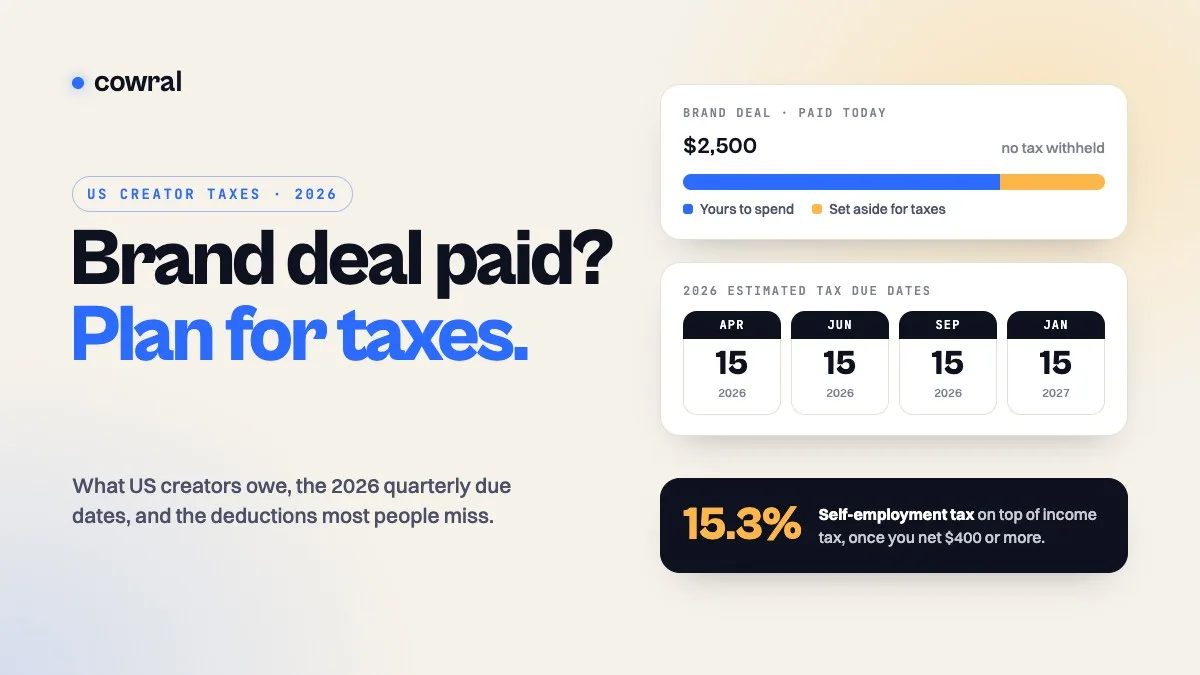
The first time a brand deal pays out, it feels like the whole amount is yours. Then April comes, and a lot of first-year creators find out the IRS sees it differently.
If you’re in the US and you earn money from content, you’re almost certainly self-employed in the IRS’s eyes. Nobody is withholding tax from your payments, so planning for it is your job. The good news is that the rules aren’t complicated once you see them laid out, and creators get to deduct a lot of what they already spend.
This guide covers what counts as income, how self-employment tax works, when to pay during the year, which forms to expect, and the deductions worth knowing. Every number comes from the IRS or the Social Security Administration and applies to the 2026 tax year.
This is general information, not tax advice
Tax situations vary a lot by state, filing status and how your business is set up. Use this guide to understand the basics and ask better questions, then check your own situation with a tax professional or the IRS pages linked below.
Key takeaways
The short answer is almost everything you get because of your content. The IRS says income can come as money, property, or services, so it isn’t only the deposits in your bank account.
For most creators, that includes:
Write down what free products are worth
Fair market value is what the item would sell for between a willing buyer and seller. Keep a simple sheet with the date, the brand, the item, its retail price, and what you agreed to post. It takes a minute per package and saves a lot of guessing next spring.
If you’re still figuring out where your money will come from, our guide to how creators get paid walks through each income stream.
When you work a regular job, your employer pays half of your Social Security and Medicare tax and takes the other half out of your paycheck. When you’re self-employed, you pay both halves yourself. That’s self-employment tax.

Here’s how it works for 2026:
| Piece | The rule |
|---|---|
| Who owes it | Anyone with net earnings from self-employment of $400 or more |
| Total rate | 15.3%: 12.4% Social Security plus 2.9% Medicare |
| Social Security cap | The 12.4% part only applies to the first $184,500 of combined wages and self-employment earnings in 2026 (it was $176,100 in 2025, and the SSA has set $192,300 for 2027) |
| Extra Medicare tax | 0.9% more on earnings over $200,000 if you’re single, or $250,000 if you’re married filing jointly |
| What it’s charged on | 92.35% of your net self-employment earnings, not the full amount |
| Your deduction | You deduct the employer-equivalent half of it when figuring your adjusted gross income |
“Net” matters here. Self-employment tax is figured on your profit, meaning what’s left after business expenses, not on everything brands paid you. That’s one reason tracking expenses pays off twice: it lowers your income tax and your self-employment tax.
Say you made $40,000 from content in 2026 and spent $10,000 on legitimate business expenses. Your net profit is $30,000.
That $4,239 is on top of your regular federal income tax, and any state income tax. That’s why many creators park a slice of each payment in its own savings account as soon as it clears. How big that slice should be depends on your bracket and state, which is a good first question for a tax pro.
The US tax system is pay-as-you-go. Since nobody withholds from your brand deals, the IRS expects you to send estimated tax payments during the year when you expect your bill at filing time to be $1,000 or more.
The 2026 due dates, from IRS Publication 505:
| Income earned | Payment due |
|---|---|
| January 1 to March 31, 2026 | April 15, 2026 |
| April 1 to May 31, 2026 | June 15, 2026 |
| June 1 to August 31, 2026 | September 15, 2026 |
| September 1 to December 31, 2026 | January 15, 2027 |

Notice the periods aren’t equal quarters. The second one is only two months long, which catches people out.
You can skip the January 15, 2027 payment if you file your 2026 return by January 31, 2027 and pay everything you owe with it.
Underpaying can cost you a penalty
If you don’t pay enough during the year, you may owe a penalty. Per the IRS, you generally steer clear of it when you owe under $1,000 once withholding and credits are counted, or when your payments covered the smaller of 90% of this year’s tax or 100% of last year’s. One exception: if your 2025 adjusted gross income was over $150,000 ($75,000 if married filing separately), Publication 505 swaps that 100% for 110%.
The “100% of last year” rule is especially useful for creators, because your income can swing a lot. If you pay in at least what you owed last year, spread across the four dates, you’re generally protected from the penalty even if this year turns out bigger (or 110%, if the higher-income rule above applies to you). You’d still owe the difference when you file.
You can pay online, by phone, through the IRS app, through your IRS online account, or by mail with Form 1040-ES. Links are on the IRS estimated taxes page.
Two forms show up in a lot of creators’ mailboxes:

The important part: these forms are just reports. The IRS is clear that you must report all your income from goods or services, no matter what’s on a 1099 or whether you got one at all. A $300 deal with no paperwork is still income.
So don’t wait for the forms to add up your year. Track your income as it comes in, then check the forms against your own records when they arrive.
To be deductible, an expense has to be both ordinary and necessary for your business. Ordinary means common and accepted for creators. Necessary means helpful and appropriate. It doesn’t have to be essential.
Things that commonly fit for creators:
A lot of creator spending is mixed. Your phone, your internet, your car. When something is used for both business and personal life, you can generally deduct only the business part. Keep a reasonable record of how you split it.
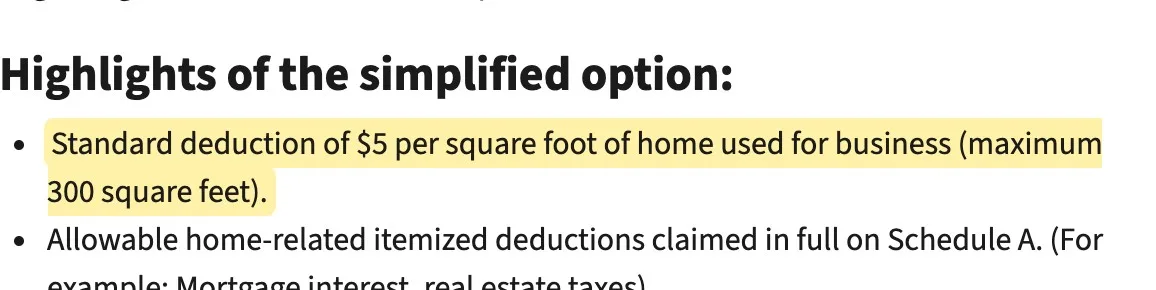
If you film or edit at home, you may qualify for the home office deduction. The test that trips most people up is exclusive use: the space has to be used only for your business. A corner of your bedroom that’s only ever your filming setup can count. The couch where you also watch TV can’t.
The simplified method is the easy route: $5 per square foot of the space, up to 300 square feet. That’s a maximum of $1,500.
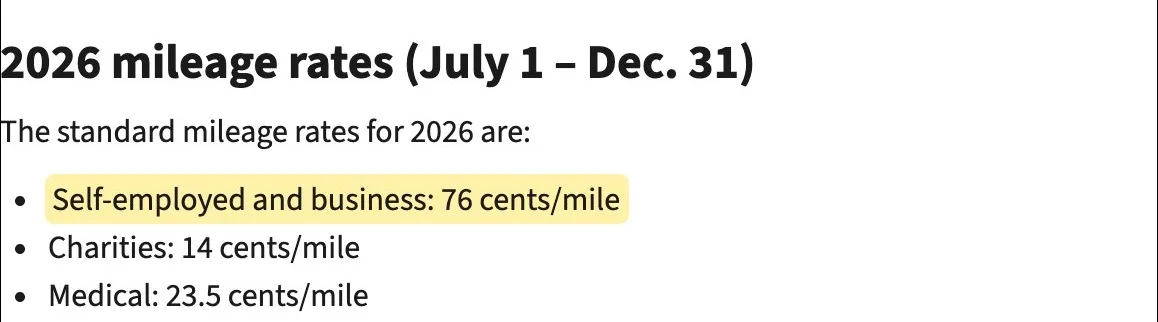
If you drive to shoots, meetings or to pick up props, you can use the IRS standard mileage rate. For 2026, the business rate changed mid-year: 72.5 cents a mile from January 1 to June 30, and 76 cents a mile from July 1 to December 31. Log the date, the trip and the miles as you go. Rebuilding a mileage log in April is miserable.
Many self-employed people can also take the qualified business income deduction, worth up to 20% of qualified business income. It has income limits and rules about which businesses qualify, and starting with tax years after 2025 the IRS lists a new minimum deduction for active qualified business income. Ask your tax pro whether you qualify. It can be a meaningful amount.
You don’t need fancy software to stay on top of this. You need a habit.
Platform payout rules change too, and they affect how and when your money arrives. Our Creator Rules Tracker keeps the current monetization requirements for each platform in one place, with a link to the official source for every rule, plus the US tax basics from this guide.
Self-employment tax only kicks in at $400 of net self-employment earnings. But you may still owe income tax depending on your total income, and the income still needs to be reported if you have to file a return. Small amounts aren’t automatically tax-free.
If you received the product in exchange for creating content, the IRS treats property received for services as income at its fair market value. Unsolicited items that come with no agreement are a grayer area, so keep a record of everything you receive and ask a tax professional how to treat the items that came with no strings attached.
Yes. A 1099 is just a report from the payer. You owe tax on all your income from goods or services whether or not a form arrives.
Not usually. If you earn affiliate commissions as part of your creator business, they’re business income like your other deals, and they count toward self-employment tax.
A single-member LLC doesn’t change much for federal income tax by default. The IRS generally treats it as a “disregarded entity”, so you still report on Schedule C. Some creators set one up for liability protection or later choose a different tax treatment. That’s a decision to make with a professional, not one to rush into in your first year.
Tax rules are one more thing to keep track of on top of making content. If you’d rather spend your time on the content, Cowral helps with the rest: planning videos, writing scripts and spotting what’s working in your niche.

Olu Sam is an SEO expert and social media content creator who built over 50K followers across his social media pages in less than a year of creating content.
LinkedIn ProfileHow we research and fact-check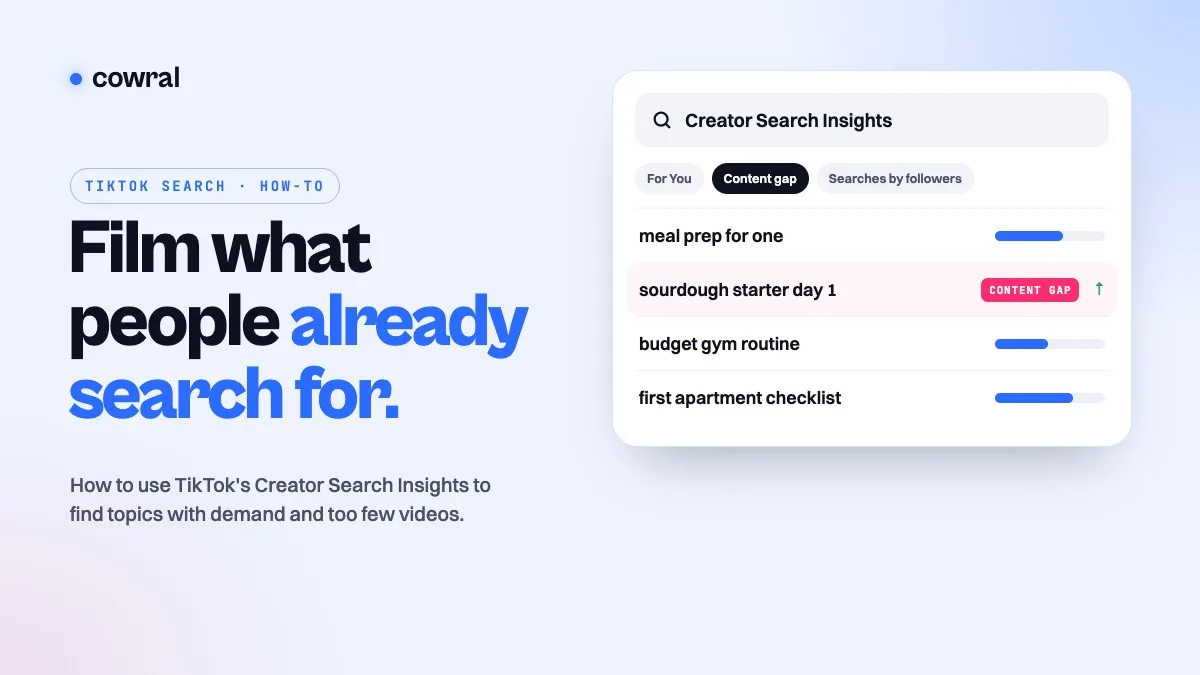 TikTokTikTok Creator Search Insights: how to find what people search for and turn it into videosCreator Search Insights is TikTok's own tool for seeing what people search for, including topics that don't have many videos yet.
 TikTokHow to cross-post to TikTok, Reels and Shorts in 2026 without getting held backPosting your own video on TikTok, Instagram and YouTube is allowed on all three. What gets held back is watermarks, other people's content...
 MonetizationCowral's affiliate program: earn 30% for a year, and how to disclose your link the way the FTC wantsCowral now pays creators 30% of every payment for a referred customer's first 12 months, and your audience gets 20% off.